Six Chiswick locations take part in the Open House Festival 12 – 20 September 2026

Open House Festival Neighbourhoods page for Chiswick
Chiswick – ‘A Neighbourhood of Contrasts’
There are several buildings in Chiswick which will be opened to the public for the Open House Festival in September, and other architectural jewels in the surrounding areas of west London available to visit.
Open House Festival, which runs from 12 – 20 September, is a London-wide festival that opens up and celebrates the city’s architecture, special sites and neighbourhoods, with open days and events taking place across all 33 London boroughs.
Run by the Open City charity, the organisers say:
“We are on a mission to make the built environment more open, accessible, and equitable”.
They run a programme of events around the festival, including walks, talks and workshops. In Chiswick they list six locations, with guided tours and walks.

Chiswick Town Hall
Chiswick Town Hall
There are two guided tours of Chiswick Town Hall on Tuesday 15 September, at 11.30am and 1.30pm.
‘In the mid-19th century St Nicholas Parish Council had met in a variety of different locations including, latterly, the Boys’ National School at Turnham Green.
‘After parish leaders found that this arrangement was inadequate for their needs, they elected to construct a purpose-built vestry hall: a site on Turnham Green, which had previously been open land, was purchased for the benefit of the parish in 1874.
‘The new building was designed by William Joshua Trehearne in the Italianate style and opened in 1876’.
Book tickets: Chiswick Town Hall

Chiswick Business Park; photograph Jennifer Griffiths
‘A Ruskinian Walk Through Shared Heritage’
Three walks are planned on Saturday 12, Sunday 13 and Saturday 19 September, starting from Chiswick Business Park, taking in different periods and styles of architecture:
‘A history focused community trail across four centuries and a mixture of architectural styles: the walk takes its cue from John Ruskin’s holistic vision of citizens’ duty to posterity (‘… when we build, let us think that we build forever’).
‘It starts at Building 3, Chiswick Business Park — RIBA Award >>> Richard Rogers Partnership 2000. Other focal features are Gunnersbury Triangle ; the heritage rich and polyglot South Acton Estate: resident-governed, self reliant birthplace of Royal Academician Patrick Caulfield … through the community owned recreation ground; past the prized South Acton Children’s Centre; crossing the ‘Stamford Brook’ to view Woodlands Park Ice House; the homes of William Willett (builder / originator of Daylight Saving Time) and Richard White, co-founder of The Law Society in the Mill Hill Park Conservation Area’.
Book tickets: A Ruskinian walk through a shared heritage

View across Stamford Brook Common; painting by Camille Pissarro (1830-1903)
Stamford Brook walk
There is a walking tour following the course of the Stamford Brook – one of London’s hidden rivers – on Monday 14 September at 10.30am.
‘The walk takes you through a culturally rich and diverse area. The architecture is also diverse, ranging from a plantation owner’s house, the home and studio of an impressionist painter, Victorian mansion blocks, the home of a woman writer, a hospital and the site of a medieval manor house, home to a king’s mistress.
‘Also, ordinary homes and businesses’.
Book tickets: Stamford Brook walk

Chiswick House
Chiswick House & Gardens
Chiswick House will be open and there will be drop in activities in the Artists’ Studios, the new Learning Hub and the Kitchen Garden on Sunday 20 September. Tours of Chiswick House are self-guided, with space limited free tours of either the House or the Gardens from 12.00-1.00pm.
The Neo-Palladian house was designed by two Georgian trendsetters, William Kent and the Earl of Burlington, the interior is ornate and filled with striking works of art. Access on 20 September will be free, but booking is required.
READ ALSO: 300 years of Chiswick House Gardens
The Artists’ Studios at Chiswick House & Gardens were created in 2025 from historic outbuildings and stables around the Kitchen Garden. Home to 23 artists from a wide variety of disciplines, they are open to the public twice a year. Visitors are invited to drop in to discover the artists’ private workspaces, meet the makers, learn about their work, take part in drop-in workshops and enjoy a little shopping.
READ ALSO: New artists studios opened at Chiswick House Gardens
The 17th century walled Kitchen Garden is a beautiful space where visitors can wander, buy fresh flowers and produce and take part in drop-in workshops.
READ ALSO: Access to Kitchen Garden in Chiswick House to be made free
The ‘Learning Hub’ is the latest development – a new space available for community activities built beside an open courtyard adjacent to the artists’ studios and the Kitchen Garden.
READ ALSO: Chiswick House & Gardens smash their crowdfunding target for new Learning Hub
Book tickets: Chiswick House & Gardens

Hogarth’s house
Hogarth’s house
There are guided tours of the garden of the artist William Hogarth’s house on Sunday 13 September at 2.30 and 3.30pm, and on Saturday 19 September at 2.30 and 3.30pm.
‘Early 18th century red brick country home of artist William Hogarth, extended significantly c. 1749-1764.
‘The 2020 extension, funded by the National Lottery Heritage Fund, added the new Weston Studio for learning and activities, and a curved glass wall in the shape of Hogarth’s Line of Beauty.
‘Delightful re-landscaped and reinterpreted walled garden containing famous ancient mulberry tree’.
READ ALSO: Hogarth’s house
READ ALSO: ‘How We Lost America’ – Exhibition at Hogarth’s House from 22 September – 1 November 2026
Book tickets: Hogarth’s house

Victorian Society headquarters in Bedford Park
Victorian Society headquarters, Bedford Park
The Victorian Society headquarters at 1 Priory Gardens in Bedford Park will be holding an open day on Saturday 12 September from 11.00 am – 4.15 pm.
‘Part of the original pioneering Bedford Park development, latterly restored by the Victorian Society and serving as its headquarters since 1973. The house itself is in a picturesque style, of three storeys, in red and yellow brick, with a Dutch gable and oriel windows. It is dated 1880, and was designed by E. J. May’.
READ ALSO: Victorian Society opens listed Bedford Park HQ for Open House Festival
There is also a walking tour of Bedford Park planned, led by John Scott, a leading expert on the history and development of Bedford Park, around the area’s architectural highlights, from 2 – 3.30pm.
Book tickets: The Victorian Society

Open House Festival map showing venues in and around Chiswick taking part
Other west London venues taking part in the Open House Festival
Other west London venues around Chiswick taking part in the Open House Festival include Pitzhanger Manor & Gallery, St John’s Church and the University of West London in Ealing, and a private house at 31 Milton Rd in Acton, which owner David Buckingham has restored from three separate flats back to its original state as a three storey Victorian home.
As Juliet McDonald reports for The Chiswick Calendar, South Ealing Cemetery – formerly known as Ealing and Old Brentford Cemetery – will also be taking part.
READ ALSO: South Ealing Cemetery’s buried secrets are brought to life
There is a tour of what remains of BBC Television Centre at White City:
‘following in the footsteps of the Beatles, Coldplay, Alfred Hitchcock and countless others….See what remains of the iconic 1960’s BBC Television Centre and the Gaumont Film Studios ….plus discover Charles Dickens’ controversial connection to Shepherd’s Bush’.
Culture House, in Shepherd’s Bush, the first permanent exhibition space for Somali artefacts curated by the Somali community, will be open to the public, as will the Quaker Meeting House in Hammersmith.
Chiswick vicar retires but will still be fighting for women’s rights in the Church
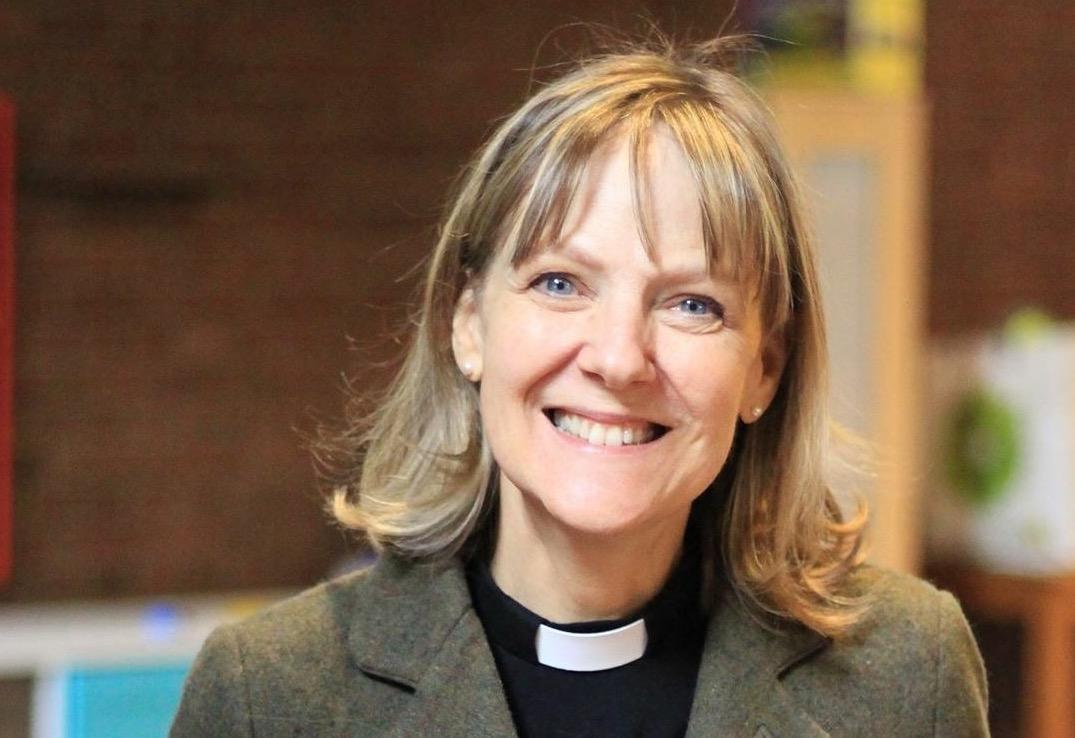
Rev. Martine Oborne
Reverend Martine Oborne will say goodbye to her congregation at St Michael’s Church, Elmwood Road, but continues to be a campaigner
After many years of supporting her parishioners through the highs and lows of life – births, deaths and all the existential crises in between – Rev’d Martine Oborne, the vicar of St Michael’s, Elmwood Road, and Area Dean of Hounslow is retiring at the end of September.
It will come as a surprise to some because Martine has been vicar here for many years and loves her church and community. She has, however, never shied from a battle – even if it’s difficult – and is known for campaigning for equality for female clergy through Women and the Church (WATCH), where she’s been chair for four years, and more recently for her concerns over the recruitment process of the Bishop of London.
READ MORE: Chiswick vicar demands that the next Bishop of London accepts female clergy
To lose someone with so much passion for fighting against gender inequality is a terrible blow for W4, so The Chiswick Calendar hotfooted it to catch up with the outspoken vicar to ask her about her big decision.
“I’m retiring now because I’m in my late sixties and I’ve been at St Michael’s for 15 years, so it’s time they take a break from me!” she says modestly.
Sitting in her vibrant yellow living room, surrounded by artworks including an oil portrait of herself and her husband, the journalist Peter Oborne, Martine looks much younger than your average retiree.

In her retirement, Martine will embrace new challenges as a campaigner and a writer
More time with the family
She is dressed in jeans and a casual shirt, and waiting for her youngest child, aged 22, to return home from a trip abroad. It’s easy to understand that after so much devoted service to other families she could crave more time with her own.
“I’ve got five children,” she says. “They’re all grown up now – only the youngest is still living here – and of course I’d love to spend more time with them.”
Three of her brood are daughters (and she also has two daughters-in-law), so when I hear her speak about the gender injustice in the world – poor maternity care, women trafficked, aborted female foetuses – I can hear the dismay in her voice and it’s very visceral.
But Martine is not abandoning the institution she has fought so hard to improve or her campaign for equality. The fight, for her, continues. If anything, it is escalating!
Once a priest always a priest
“First, I will still have permission to officiate and can take services in London – at St Martin’s in the Field, for example – if I am asked to.”
“Also, I’m going to stand for General Synod.”
This second piece of news is significant because it is the General Synod – composed of three houses – that is the legislative body of The Church of England and where all the decisions are made.

Martine Oborne at Waterstones, a key supporter of the Chiswick Book Festival
Speaking out for the community
For Martine, the election is a once-in-five-year opportunity to speak for her community and the diocese at a national level. If elected on 13 October, she would be one of 11 members of clergy representing London and would have to attend meetings for the next five years on an unpaid basis.
“It’s important to be in the room,” explains Martine. “Yes, I’ve been chair of Women and the Church for which I’ve written articles, campaigned and signed petitions, but the synod is what matters.”
Standing up for what you believe
“I’m probably too outspoken for most people’s tastes,” she says, “but I’ll stand as a candidate and see. I’ve been very forthright in my election statement.
“I feel it’s wrong that we don’t have full equality for women in the Church. It has changed a lot in 30 years, but the Church should be taking more of a lead on gender injustice.”
Whilst it’s not unusual that an experienced priest might stand for General Synod, it is perhaps a little surprising that they also express their ideas in a satirical work of fiction. In interesting timing, Martine is launching a novel, just as her peers are voting on her, that gently bashes the institution they all serve.


The Trials of Jessica Lovegood will be on the shelves at Waterstones
Publishing a new book – ‘The Trials of Jessica Lovegood’
The Trials of Jessica Lovegood is described as “funny, moving and sharply observed” and is about a vicar whose boss doesn’t believe that women should be priests.
READ ALSO: The Trials of Jessica Lovegood – new book by Rev. Martine Oborne
READ ALSO: Lineup of authors announced for Chiswick Book Festival 2026 Local Authors Showcase
“I’m going to launch it at the Chiswick Book Festival and I’ve got a slot on 9 September at the George IV pub, where I’ve got two minutes to pitch my book to the audience,” explains Martine.
Always sold out in advance, the Local Authors Showcase is a much-loved event of the festival and gives Chiswick-based authors the chance to do an elevator pitch to a packed-out Boston Room where they are hilariously hooted off stage if they go over their allotted time.
Bringing humour to the fight
As a vicar who is accustomed to public speaking, Martine is up for this challenge, and we had quite a laugh when she told me about her novel and its strong premise.
“Jessica Lovegood is a vicar – not in Chiswick – but in Wishmoor, an old mining town in the north of England.”
Asked whether her own experience helped her create fully realized characters, she replied that “there are always archetypes everywhere, but I didn’t want to set my story in Chiswick, so it’s definitely not my own church.”
The congregation of St Michael’s, Elmwood Road, can breathe a sigh of relief (or even disappointment), and although Martine maintains her book is not autobiographical, there are themes that will resonate with anyone who knows of her work.
In addition to the Local Authors Showcase at the Chiswick Book Festival, you can also join Martine at her online event on 24 September from 7-8pm where she will be in conversation with Christina Rees CBE. Copies of The Trials of Jessica Lovegood will be available at Waterstones and the independent shop Bookcase in Chiswick High Road and on Amazon.
Brentford sign Senegal left-back Malick Diouf from West Ham

The 21 year old is Brentford’s fifth signing of a big-spending summer, and arrives as the Bees make a flying start to the season
Brentford have completed the signing of Senegal international El Hadji Malick Diouf from West Ham United. The left-back has signed a five year contract, running until the summer of 2031, with the option of an additional year.
The transfer fee was not disclosed by either club, but is widely reported to be worth around £40m. West Ham signed Diouf from Slavia Prague for around £19m last July, so the sale looks to be a significant profit for the east London club after just one season.
It is Brentford’s fifth permanent signing of the summer, and their second most expensive after Mamadou Sangaré’s club-record £41m move from Lens.
READ ALSO: Henderson out, Sangaré in: Brentford’s midfield rebuild begins to take shape
READ ALSO: 2026/27 season preview: How high can the Bees go?
The club also brought in centre-back Jannik Schuster from Red Bull Salzburg (£17.2m), winger Jaidon Anthony from Burnley (£17m) and striker Callum Wilson on a free transfer, also from West Ham. Jordan Henderson left for Chelsea on a free, Frank Onyeka joined Coventry, and Ethan Pinnock was sold to Coventry for £5m.
Reported fees put this summer’s gross outlay at well over £110m, one of the highest in the club’s history.
Diouf strengthens a position Brentford have been short of cover in, with first-choice left-back Rico Henry having missed long spells over the past two seasons through injury.
Head coach Keith Andrews said: ‘He’s a player that fits our ideal age profile, with lots of room to still develop.’
Born in Dakar, Diouf began his career at Galaxy Football Academy and Académie Mawade Wade in Senegal, before joining Norwegian side Tromsø in February 2023. He moved to Slavia Prague in January 2024, helping the club win the Czech First League by 16 points in 2024/25, then joined West Ham last summer, making 32 Premier League appearances with five assists in 2025/26.
He is a full Senegal international, having made his debut against Burundi in September 2024. He played at the 2025 Africa Cup of Nations and the 2026 World Cup, and started when Senegal beat England in June 2025.
The signing comes as Brentford look to build on last season’s ninth place finish, their best in the Premier League, when they missed out on Europe by a single point.
Brentford made a strong start, beating Tottenham Hotspur 3-0 at the Gtech Community Stadium on the opening weekend, and sit third in the table after one game.
Diouf said he had studied Brentford’s style of play before agreeing to join. ‘I watched them a lot last season. The team is very athletic and I have that profile as well, so I think I can adapt well to the team,’ he said. ‘They gave me a good plan for how I can develop, so I think it’s a good place for me to be.’
Yard Sale Pizza to open on Chiswick High Road this autumn

The delivery-led chain’s first Chiswick shop joins a busy year for pizza on the west London food scene
Yard Sale Pizza is opening a new shop at 88 Chiswick High Road this autumn, offering delivery, collection and a handful of seats for dine-in.
Delivery from the site will cover Chiswick, Gunnersbury and Hammersmith, along with parts of Acton, Barnes and Shepherds Bush, handled by Yard Sale’s own fleet of drivers and cyclists rather than through delivery apps, a model it’s run since starting in 2014.
The menu includes 12-inch and 18-inch pizzas such as the ‘Holy Pepperoni’ and the ‘TSB’, alongside rotating specials that have included collaborations with Dishoom, Ottolenghi and BAO.
It joins a busy year for pizza in Chiswick. Sonay Ali’s Doctor Dough opened its first permanent restaurant on Devonshire Road earlier this month, a few doors from Napoli on the Road, the pizzeria named Europe’s number one by the 50 Top Pizza awards for the third year running. Both are members of The Chiswick Calendar’s Club Card scheme.
READ ALSO: Instagram sensation Doctor Dough is to open his first restaurant in Chiswick
READ ALSO: Napoli on the Road retains title of Best Pizzeria in Europe bar Italy
Yard Sale Pizza was founded by three friends thirteen years ago and now has eighteen shops across London. It has also raised more than £100,000 for charities including Hackney Night Shelter and CALM, and fed more than 8,000 NHS staff for free during the pandemic through its NHS Pizza Fund.
You can sign up now for a launch offer at yardsalepizza.com.
TFL marks anniversaries of both Caribbean recruitment campaign and Notting Hill Carnival

Woman in a tiger head costume at Notting Hill Carnival, photograph taken by Hugh Robertson. From London Transport Museum’s collection.
TfL marks 70 years since London Transport’s Caribbean recruitment campaign and 60th anniversary of Notting Hill carnival
TfL is marking 70 years since London Transport’s Caribbean recruitment campaign which brought immigrants from the West Indies to work in London after the war, and 60 years since the creation of the festival of Caribbean culture that is the Notting Hill Carnival.
To honour the pioneers of the Notting Hill Carnival, TfL have worked with Nubian Jak Community Trust to create a 60 year anniversary plaque that will be installed at Westbourne Park, where the carnival starts, on Friday 28 August.
The names of seventy of those who have made contributions to the development of the carnival have been selected to appear on the plaque. People who have participated through costume, sound, the creative and the cultural aspects of the Notting Hill Carnival are being honoured.
A Go Ahead London Bus with bespoke Notting Hill Carnival advertising panels will take part in the carnival parade on Sunday 30 August. This year’s Carnival theme of ‘Generations in Motion’ will be the focus of this specially branded bus. The theme intends to celebrate the passing of culture, knowledge and creativity through generations.


(L) Agatha Claudette Hart, a London bus conductor, working at the Stockwell bus garage in March 1962 – photograph London Transport Museum; (R) Member of staff in the new enquiry office at 55 Broadway, 1977 – photograph HJ Hare & Son / London Transport Museum
“Legacy, family and community”
The Chiswick Calendar spoke to Chris Sampson, an executive manager at TfL, who told us about his uncles who came over from St Lucia and worked for London Transport, and why celebrating Notting Hill Carnival is so important to Black Londoners with West Indian roots.
Chris’s family started coming to London in the 1950s and both his uncles worked for Transport For London, one as a bus mechanic and the other as a conductor on the buses.
He recalled happy memories of his uncle coming over to his house to have a drink and play dominoes between his shifts at the bus station where he worked, which was opposite his childhood home.
Chris reminisced about playing with his uncle’s uniforms and ticket machines and how as a young boy he used to wonder:
“How do you look so smart when you work underneath buses?”
He talked about working for TfL giving his family a “real sense of pride”. Seeing his uncles engaging with customers and the “legacy, family and community” he associated with the organisation, inspired him to work for TfL himself.
Talking about his own memories of going to carnival in the 1970s, Chris said Westbourne Park, where Notting Hill carnival takes place, was a “melting pot of different areas of the Carribean”.
Chris worked on the celebrations for the 75th anniversary of the Windrush at the Notting Hill Carnival in 2023. He told me:
“I wanted to bring every generation to experience it”.
Veterans of the Empire Windrush ship, which brought hundreds of Caribbean people who had answered the call to help rebuild Britain’s post-war economy in June 1948, were on the electric bus organised by TfL at that carnival.
Seven of them between the ages of 98 and 103, had never been to carnival because when they were working it had been a great opportunity to earn money. Chris wanted all those people to be “present in the moment”.

Celebrating the 75th anniversary of the Windrush. Picture from TfL.
Celebrating with all generations
Chris emphasised the importance of inclusivity when celebrating carnival: “whether you can’t walk and are in the bus or can walk and are walking alongside it.”
After the success of this celebration, Chris said they “didn’t want this to be a one off event”. There are 25 bands who have permits to be in the carnival every year and every year TfL will be with a different band.
“These celebrations are about bringing the present, past and future together. We want you to be experiencing the moment” said Chris.
Since the success of the celebrations marking the Windrush anniversary, the carnival is now part of TfL’s corporate calendar.
When I asked Chris what he was most looking forward to at this year’s carnival he told me:
“I’m looking forward to engaging with the generations coming up behind me. Seeing a six year old in the crowd or a 16 year old makes me think that at some point they’re going to be where I am.”
“I don’t want it to just be about who was there 60 years ago, I want it to be future generations. That is probably my favourite part, it used to be dancing but now I think I’m with my mum (who is now 82) on that one.’
Metropolitan Police expands fleet of e-bikes to catch e-bike criminals

Metropolitan Police oficers with new e-bikes
‘They are a game changer in the fight against phone theft”
The Metropolitan Police reports the force is stepping up its fight against gangs who use e-bikes and mopeds to commit crime across London, by increasing its own e-bike fleet.
But that only means increasing it from five to 25.
What they describe as the ‘significant increase’ is part of the force’s ‘continued drive to cut street crime and use the latest technology to stay ahead of criminals’, they say.
The lightweight bikes enable officers to cut through traffic, navigate narrow streets and even tackle staircases, allowing them to reach and catch criminals in places inaccessible to conventional police motorcycles and cars.
‘They are a game changer in the fight against phone theft, enabling officers to pursue offenders quickly and intervene moments after a snatch offence. This has helped reduce phone theft by more than 13,000 offences across London in the last year’.
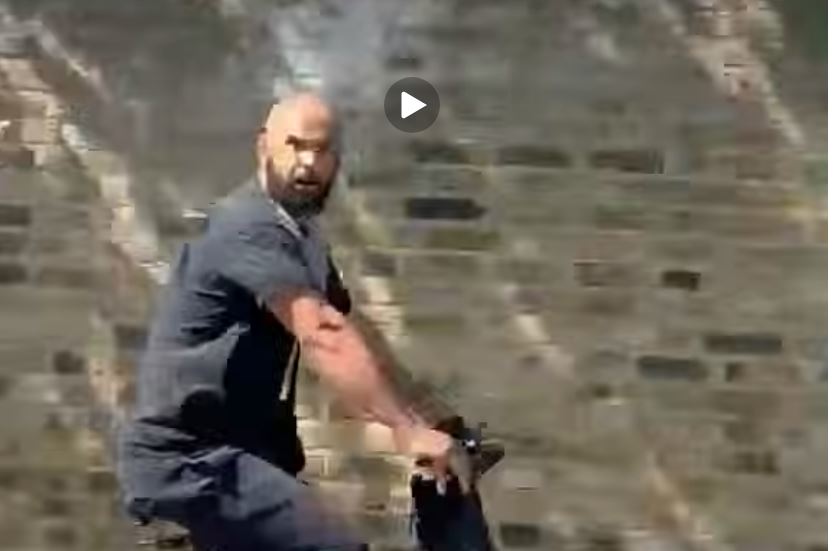
E-bike thief caught on camera after a bike was stolen from outside the Co-Op by Chiswick Station
“Criminals are using high-powered, often illegally modified e-bikes to commit offences such as phone theft and robbery”
Two Chiswick residents recently tried to help a young woman whose e-bike was stolen from outside the Co-Op by Chiswick Station by giving chase in their car, but the thief got away from them by zipping along the pavement beside Chiswick House.
READ ALSO: Man who steals electric bike by Chiswick Rail Station clearly caught on camera as locals give chase
One of the pursuers told The Chiswick Calendar:
“They’re so fast, these bikes. I don’t know how the police catch them”.

Illegal e-bike seized in LB Hounslow by police last autumn
“Londoners are already seeing the results of our relentless focus on tackling street crime”
Announcing the expansion of the Met’s e-bike fleet, Louise Puddefoot, Deputy Assistant Commissioner for Frontline Policing, said:
“Criminals are using high-powered, often illegally modified e-bikes to commit offences such as phone theft and robbery. By expanding this capability, we have listened to our officers, giving them the tools they need to disrupt criminality and keep Londoners safe.
“Londoners are already seeing the results of our relentless focus on tackling street crime, with neighbourhood crime down 14 per cent over the past year and 13,000 fewer phone thefts.”
READ ALSO: Met dismantles suspected smuggling gang in UK’s largest phone theft crackdown
The Met has released bodyworn video footage of two recent incidents showing the value of the Sur-Ron bikes.
On 17 August, officers responded to reports of an illegally ridden, uninsured e-bike. When the rider attempted to flee, officers were able to match the bike’s acceleration and maintain pursuit. The suspect lost control and was detained, with the bike seized.
On 21 August, officers at a vehicle stop site spotted a moped rider attempting to evade police. A Sur-Ron riding officer pursued the suspect through traffic and into a housing estate.
When the rider fell and fled on foot, the officer was able to maintain pursuit due to the bike’s agility and light weight. The suspect was arrested and found in possession of a significant quantity of Class A drugs. He was also a disqualified driver riding a moped displaying false plates.
So far this year, officers have seized more than 2,500 illegal e-bikes and e-scooters, often modified with high-powered batteries or uninsured.
READ MORE: Police seize illegal e-bikes in Chiswick High Road
Victorian Society opens listed Bedford Park HQ for Open House Festival

The façade of No. 1 Priory Gardens, home of the Victorian Society. Photo credit essential: Connor McNeill / The Victorian Society
Free entry to 1 Priory Gardens on Saturday 12 September, with a bookable Bedford Park walking tour also on offer
The Victorian Society will open its Grade II listed headquarters in Bedford Park to visitors on Saturday 12 September, as part of Open House Festival 2026.
The building at 1 Priory Gardens was designed by E. J. May and built in 1880. It’s a couple of minutes’ walk from Turnham Green tube station, and has been the Victorian Society’s headquarters since the 1970s. The house was later owned by the Liberal MP Llewellyn Atherley-Jones, and once housed the Bedford Park Printing Press, before being divided into flats.
Visitors can drop in any time between 11am and 4.15pm on the day. Entry is free and no booking is required.
A separate, free guided walking tour of Bedford Park is also being offered on the same day, though places must be booked in advance via the Open House website.
Full details, and the tour booking link, are on the Open House programme page and the Victorian Society’s website.
The Victorian Society headquarters at 1 Priory Gardens is one of six locations in Chiswick taking part in this year’s Open House Festival, with many more buildings in Ealing, Acton, Hammersmith, Shepherd’s Bush and Brentford also opening their doors to the public.
READ ALSO: Six Chiswick locations take part in the Open House Festival 12 – 20 September 2026
The Victorian Society suggests combining the visit with an event at the Chiswick Book Festival, which runs over the same weekend.
READ ALSO: Nick Clegg, Kate Mosse and a Beatles anniversary feature in this year’s Chiswick Book Festival
Nick Clegg, Kate Mosse and a Beatles anniversary feature in this year’s Chiswick Book Festival

Full programme of festival events available here – Chiswick Book Festival brochure
Five sessions to catch across the festival
The 18th Chiswick Book Festival runs from Wednesday 9 to Monday 14 September.
Friday, Saturday and Sunday’s events are held within five minutes of Turnham Green tube station, at St Michael & All Angels Church and Theatre at the Tabard, with a handful of sessions further afield at George IV, Chiswick House and Hogarth’s House.
It is run as a non-profit community event by St Michael & All Angels, and has raised more than £170,000 for charities since 2009. This year’s beneficiaries are the church itself along with three reading charities: Koestler Arts, Read for Good and Read Easy Ealing.

Local Chiswick authors with new books out this autumn
Local Authors’ Showcase
The week opens with the Local Authors’ Showcase on Wednesday 9 September (7pm to 9pm, Boston Room, George IV, £12), where Chiswick residents get two minutes each to pitch their books to a packed room.
READ ALSO: Lineup of authors announced for Chiswick Book Festival 2026 Local Authors Showcase
This year’s line-up includes vicar-turned-novelist Rev Martine Oborne, Tabard associate director Nick Bromley and theatre reviewer Simon Thomsett among a run of local writers covering everything from Young Adult fiction to a history of Trent Park, which in the winter of 1939-40 was transformed into a state of the art surveillance centre.

The Beatles at Chiswick House, 20 May 1966; Photograph Robert Whitaker, via Chiswick House and Gardens
Beatles Day at Chiswick House
Thursday brings Beatles Day at Chiswick House, timed to a genuine local anniversary. On 20 May 1966, the Beatles spent an afternoon filming promotional clips for Paperback Writer and its B-side Rain in the gardens at Chiswick House, using the conservatory, the walled garden and the Exedra as backdrops.
Directed by Michael Lindsay-Hogg, who later made Let It Be, the films are widely regarded as forerunners of the modern music video. One of the cedar trees the band sat under, since nicknamed the Beatles Tree, was shortlisted for the Woodland Trust’s Tree of the Year in 2025, though it lost out to an ash tree in Glasgow.
At 2.30pm, Blue Badge guide Guy Fairbank leads a 90-minute walk from the café at Chiswick House & Gardens tracing the Beatles’ connections to the area and on to Chiswick Mall (£15).

The ‘Beatles Tree’ in Chiswick House Gardens; Photograph Woodland Trust
At 7pm, in the Garden Pavilion (£17.50, bar and books on sale from 6pm), broadcaster Samira Ahmed chairs a discussion between Beatles historian Mark Lewisohn, author of The Beatles: All These Years, Volume 1 – Tune In, and Tony Palmer, director of the 17-part 1970s documentary series All You Need Is Love: The Story of Popular Music.
Samira Ahmed has her own new Beatles book out, a BFI Film Classics study of A Hard Day’s Night, much of which was shot around Twickenham, Isleworth and West Ealing.

Nick Clegg; Photograph Chiswick Book Festival
Nick Clegg – How to Save the Internet
Friday’s programme features two very different writers. At 6.15pm, former Deputy Prime Minister Nick Clegg, who recently moved to Chiswick, talks to Radio Times columnist Caroline Frost about How to Save the Internet, written after he stepped down as Meta’s President of Global Affairs.
READ ALSO: Tickets go on sale for Chiswick Book Festival with Nick Clegg and Jacqueline Wilson among speakers
The book argues that democracies, an increasingly insular Silicon Valley and authoritarian states are all pulling at the open internet from different directions. It has had a mixed critical reception: some reviewers have welcomed its insider’s account of Meta’s decision-making, while others, including the Guardian’s Jonathan Haidt, have argued Clegg leans too heavily on the company’s own past defence of itself.

Kate Mosse; Photograph Chiswick Book Festival
Kate Mosse – Autumn
At 8pm, novelist Kate Mosse talks to journalist Natasha Poliszczuk about her career, thirty years on from founding the Women’s Prize for Fiction, and her forthcoming book Autumn. It is the third in a seasons series that also features Michael Morpurgo, Bernardine Evaristo and Val McDermid, and follows Mosse back to the Sussex marshes of her childhood. This session is sponsored by The Chiswick Calendar.

Wendy Joseph KC; Photograph Chiswick Book Festival
Wendy Joseph KC – Rough Justice
Saturday morning belongs to the law. At 11am, Wendy Joseph KC, who became only the third woman to hold a permanent judicial post at the Old Bailey when she joined in 2012, talks to human rights lawyer Dexter Dias KC in the Parish Hall. Her book Rough Justice follows her Sunday Times bestseller Unlawful Killings and draws on cases from her years as a murder trial judge to ask how much the justice system has really changed for the people who pass through it.

Dame Jacqueline Wilson at Chiswick Book Festival in 2016; Photograph Chiswick Calendar
These five sessions are only part of a much fuller programme which also includes a spies double bill with Ben Macintyre, Charles Cumming and Jane Thynne, Robert Hardman and Catherine Mayer marking the centenary of Elizabeth II’s birth, Mary Portas on her career and her memoir I Shop, Therefore I Am, Fergal Keane on leaving the BBC after 37 years, and children’s author Jacqueline Wilson, among many others.
READ ALSO: Chiswick Book Festival reveals first details of a packed programme for 2026
The full brochure, with the complete day-by-day programme, is available to view on the festival website, along with tickets for all sessions:
A team from Waterstones’ Chiswick branch will be selling books after each event, and most authors stay behind to sign copies.
Squatters announce their intention to stay put at The Italians in Chiswick High Road

The Italians premises on Chiswick High Road has been occupied by squatters; photograph Annabel Moody
They claim they are legally entitled to be there and threaten to prosecute anyone who tries to force entry
A sign has appeared on the door of the premises on Chiswick High Road which until recently was occupied by The Italians specialist grocery and wine bar, announcing it has been occupied by squatters and they intend to stay.
The notice is titled: ‘This pub is a non-residential building. Section 144, LASPO does NOT apply’.
Section 144 of the Legal Aid, Sentencing and Punishment of Offenders Act 2012 (LASPO) made squatting in a residential building a criminal offense in England and Wales. It came into force on September 1, 2012, changing residential squatting from a purely civil matter into a criminal one that allows for police arrests and prosecution.
 The sign asserts that the building, left empty by The Italians, is not a residential building and that the stated intention of the Ministry of Justice in introducing the legislation was that the Government would not seek to criminalise squatting in non-residential buildings such as disused factories, warehouses or pubs.
Therefore it would be illegal to arrest them and initiate a criminal prosecution.
“They obviously know what they’re doing”, a property expert told The Chiswick Calendar.
“It will be time consuming and expensive to get them out”.
The squatters’ message warns they are occupying the building, that there is someone there at all times, and any entry or attempt to enter without their permission would be a criminal offence.
They go on to say that if anyone tries to force entry, they will prosecute them.
‘If you want to get us out you will have to issue a claim for possession in the County Court or in the High Court’.
The Italians closed the bakery at 454-456 Chiswick High Road in December last year. At that point they said it was their intention to keep the deli counter and wine bar at 460 Chiswick High Road open, but they also subsequently closed.
READ ALSO: The Italians close bakery on Chiswick High Road
The Chiswick Calendar understands they hold the lease until 2036, so it would be their responsibility to repossess the building, not the landlord’s.

The Italians premises on Chiswick High Road; photograph Annabel Moody
The Chiswick Calendar has tried contacting the various numbers for The Italians on their website, but we receive the same message from all of them: ‘Calls are not currently being connected to this number’,
Chiswick Cameras moves to Teddington – at least temporarily

Chiswick Camera Centre
As Chiswick Cameras lease ends and the shop moves to Teddington, owner Andy Sands is “still hoping to find somewhere else in Chiswick”
The owner of Chiswick Cameras, Andy Sands, has announced the businesses is moving to Teddington.
His lease at 4 Chiswick Terrace has come to an end and he has to move out by 18 September. The shop will close on Thursday 10 September and Andy and his colleagues will move to Teddington Photographic, 17 Broad St, Teddington TW11 8QZ.
The Chiswick Cameras name, email address and phone number will remain the same.
“I am going to be in Chiswick quite a bit, so I can still arrange pick ups and drop offs. I can still meet people and deliver things here”.
At the moment he considers the move temporary, as he has arranged to rent premises in Teddington until the end of March, which he says are half the rent and half the rates of Chiswick.
“I might still find other premises in Chiswick”, he told The Chiswick Calendar, “but it is so expensive; I looked at a place in Devonshire Road that was half the size of the shop I have now and they wanted £29,000 a year for a ten year lease”.
The business rates were £12,000 a year.
“It’s ridiculous, just crazy. It has just become unaffordable”.

Andy Sands with the article in National Geographic featuring his pictures of slime molds
Andy Sands one of Britain’s top wildlife photographers whose work has been featured by National Geographic
Andy has been in Chiswick more than 20 years and has built a reputation for excellence at Chiswick Cameras. Not only does he sell camera equipment but he offers his advice for free and Saturday mornings have become almost an unofficial camera club, with people popping in to ask his opinion.
Andy is a very well respected wildlife photographer, whose pictures are seen in books, magazines and calendars. National Geographic devoted eight double pages to his photographs in May 2023.
READ ALSO: Chiswick wildlife photographer featured in National Geographic
READ ALSO: Andy Sands, Wildlife Photographer profile
He is very much in demand giving talks to photography clubs.

CGI of new dementia care home planned for the site
Shop to be replaced after more than 20 years by a new development providing specialist dementia care
Chiswick Terrace is being redeveloped as a dementia care home. Bathroom shop CP Hart is moving out at the end of this week, and Chiswick Cameras will be the last to go.
READ ALSO: New dementia care home in Chiswick gets the go-ahead
The seven shops alongside the Old Pack horse pub will be demolished to make way for a six-storey specialist care facility with 85 bedrooms above a 172 square metre retail unit at ground and basement level.
The Trials of Jessica Lovegood – new book by Rev. Martine Oborne
Martine with copies of her book at Chiswick Watersones; photograph Juliet McDonald
A review, and interview with the author
Chiswick vicar Martine Oborne is launching a new novel at this year’s Chiswick Book Festival.
The Trials of Jessica Lovegood, about what it is like to be a female priest in the Church of England, is not Martine’s first book.
The vicar of St Michael’s Church, Elmwood Road, Chiswick, published three novels in the early 2000s – Mother Love, about juggling a full-time career in the City with having children, (she has five), Baby Love, about a woman who struggled to conceive, and Getting Even, about sibling rivalry, but it is a while since she has published anything.
She spoke to us about what had prompted her to write her latest novel.
“I wanted to write a story about the experience of being a female vicar within the Church, but I wanted it to be a proper story”, she told The Chiswick Calendar.
“It is a gentle and moving story about what life is like working in an ordinary parish”.
It is odd reading a book by someone you know. I can hear Martine’s voice, her tone, her exasperation as she describes the bishop who is her central character’s boss, who does not believe women should be priests.
He is a lonely man who’s obsessed with order, routine and his cherry-head tortoise, and he and Jess loathe each other with a passion.
Rev. Martine Oborne
There is an undertone of serious frustration to the book. Martine does not suffer fools gladly and neither does her character Jessica.
“The London diocese is extremely conservative on women and on LGBT people”, she told me.
“About 20% churches in London restrict women’s roles, about 80 out of 400 churches. They do it very quietly”.
Martine is the chair of Women and the Church (WATCH) and earlier this year she publicly supported a petition to try and persuade the Church of England against appointing a new bishop in London who does not approve of the ordination of women.
READ ALSO: Chiswick vicar demands that the next Bishop of London accepts female clergy
She is retiring as vicar of St Michael’s Church, Elmwood Road this September.
“I’m retiring now because I’m in my late sixties and I’ve been at St Michael’s for 15 years, so it’s time they take a break from me!” she told The Chiswick Calendar’s reporter Juliet McDonald.
READ ALSO: Chiswick vicar retires but will still be fighting for women’s rights in the Church
Martine will still continue to campaign for the rights of women in the Church of England and will be standing for the General Synod.
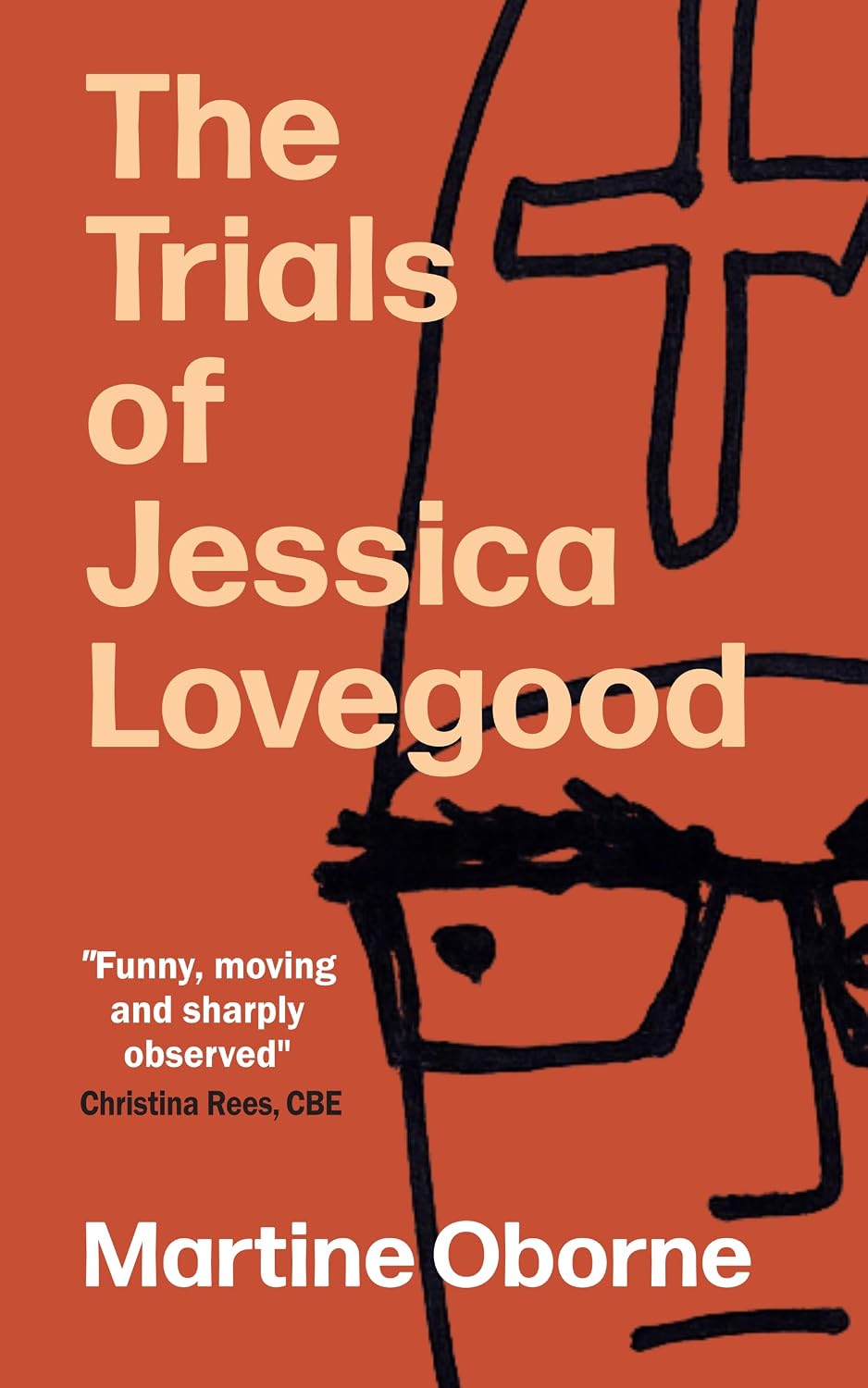 Despite the underlying seriousness, The Trials of Jessica Lovegood is a light and easy read.
“I wanted to do it with a light touch because I do bash the Church quite a bit, so this has a gentle tone; it’s funny, moving and accessible to anyone”, she told me.
The multi-talented author has also illustrated her new book with her own pen and ink drawings of the key characters.
I was prepared not to like this book because I don’t believe in miracles, and it is predicated on the idea that Jessica has the gift of healing – she can heal ‘anything from bunions to tumours’, by saying a prayer over someone.
But I thoroughly enjoyed reading it. Martine writes about the maelstrom of a vicar’s life, running a cafe where people can drop in and contribute to a communal jigsaw, and visiting people in hospital with an insider’s knowledge based on many years of dispensing concern and support over tea and lemon drizzle cake.
Jess discovers her superpower in the wake of her husband’s death from cancer in his forties. As a vicar, death and dying and dealing with grief is all very familiar territory, so Martine writes about it very convincingly and quite matter-of-factly.
She wears the theology lightly. Jess has been saying prayers for people throughout her ministry but never actually expects them to work. Their sudden efficacy is nothing short of miraculous and she feels ‘seriously weird’.
In scenes reminiscent of The Life of Brian the ailing public pursues her, alienating her daughter Emme, who can’t understand why, if she can heal people through the power of prayer, Jess had been unable to cure her father.
That must be the most difficult conversation to have in real life as a vicar, especially with your own children – if God is so great why do they permit such cruelty and suffering? I have never heard a particularly convincing answer to this, and Martine does not offer one here.
The core of the book is the growing rift between Jess and her daughter as her fame as a healer spreads, and her obsessive-compulsive boss, the bishop, seeks to use it for his own career enhancement.
The story is told from each of their three perspectives in turn. There is a touch of the Tom Sharpe to the ludicrousness of it all and the cartoon nature of some of the characters. Tom Sharpe’s father was a minister. Maybe there’s something about spending too much time around religious establishments which encourages parody and caricature.
I somehow wasn’t expecting The Trials of Jessica Lovegood to be satirical, but that is the only way I can describe the way in which Martine lampoons the effect Jess’s miraculous healing power has on the church establishment and in turn on MI6 and the government.
I was itching to know whether the bishop was based on a particular bishop she knows – she says not – or whether he is an amalgam of all the embittered male clergy she has encountered who oppose the ordination of women and seek to restrict their influence in the Church.
“People will make comparisons with certain bishops, but I have been fairly careful”.
If there is an underlying message to the book, it is about the power of friendship, says Martine.
“There are no answers as to why there is suffering in the world, and no fixes. But there is friendship. There are people around you who will help you get through tough times”.

Local Chiswick authors taking part in this year’s Local Authors Showcase
Martine will be one of 20 authors presenting their new work at the Chiswick Book Festival Local Authors Showcase on Wednesday 9 September in the Boston Room of George IV.
READ ALSO: Lineup of authors announced for Chiswick Book Festival 2026 Local Authors Showcase
The Trials of Jessica Lovegood will be available from Waterstones and the independent shop Bookcase in Chiswick, and you can also buy it online from Amazon.
Celebrating Chiswick RNLI: A farewell to the crew and volunteers
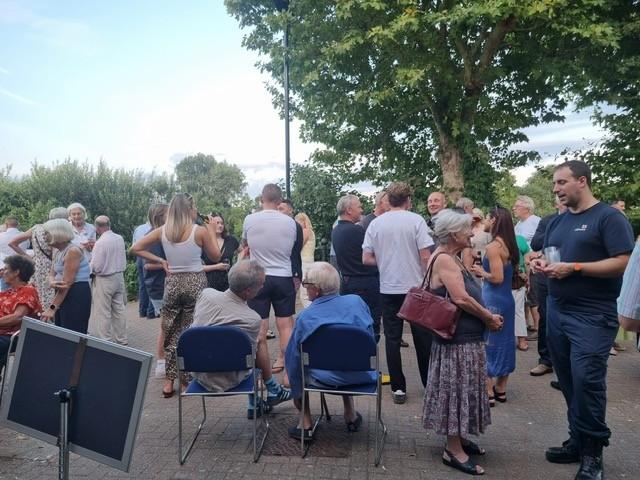
The Chiswick Pier Trust says goodbye to the Chiswick RNLI lifeboat station as it relocates to Wandsworth next month
Guest blog by David Rust, General Manager of The Chiswick Pier Trust
For those of us who live near or regularly use the Thames paths around Chiswick, the presence of the RNLI lifeboat station has become a familiar and reassuring aspect of river life.
Whether responding to a vessel in trouble, helping someone in difficulty or simply offering a kind word, the Chiswick lifeboat crew and its 80 volunteers have consistently demonstrated the professionalism and dedicated community service for which the RNLI is renowned.
But Chiswick is no backwater lifeboat station. As the second busiest lifeboat station in the British Isles, our Chiswick RNLI crew have rescued 27 people from the water this year alone. Since 2002, they have responded to 5600 incidents and directly saved the lives of 240 souls. Chiswick has been so fortunate.

The Chiswick lifeboat crew
However, after 24 years, Chiswick RNLI station is relocating to Wandsworth next month. For the Chiswick community, there will inevitably be a sense of loss as the familiar presence of the lifeboat station moves downstream.
Whilst it is sad to say farewell, the reasons for the move are understandable: The much larger RNLI station building will bring much more dedicated space, allowing essential regional crew training courses, large fund-raising events and a retail shop.
James McConnell, Co-Chair of Chiswick Pier Trust, lamented the loss of the RNLI. Since 2002, they have been much more than a tenant or house mate, but a treasured member of our family.
He likened it to being proud parents seeing their child finally leave home: “Your heart is broken and you don’t want them to go, but at the same time you are immensely proud that they have at last got on the property ladder just down the road”
We, at Chiswick Pier Trust, simply could not let them go without giving them a good send off.
On Friday, August 14, we opened our doors and welcomed many representatives of the community, from river organisations, rowing and sailing clubs, RNLI administration, Sea Cadets, Hounslow Council, houseboat residents and those who simply wanted to express their gratitude.
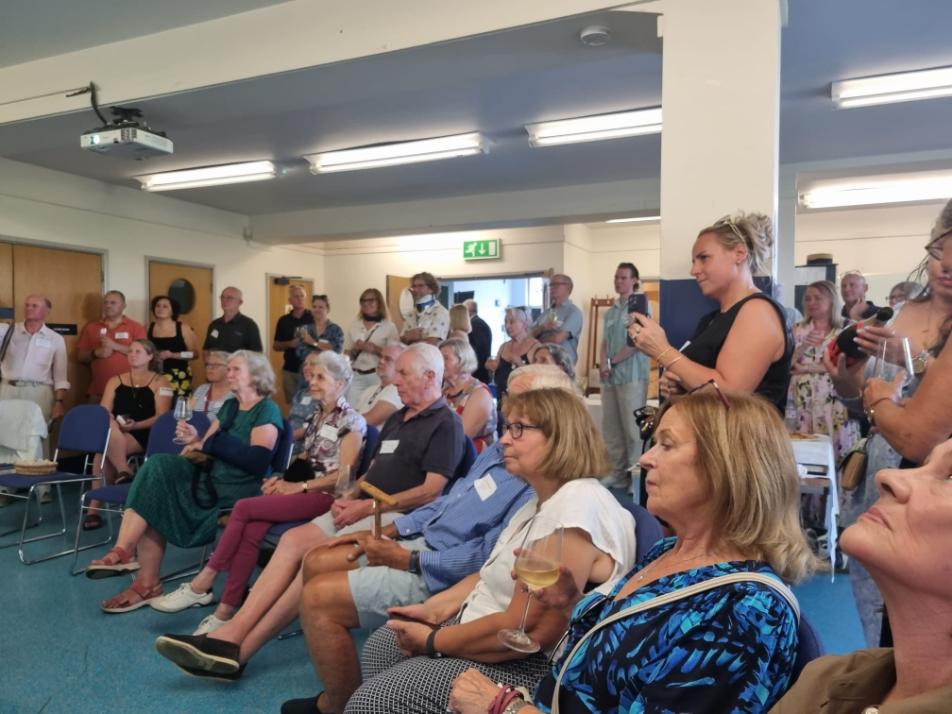
The event ran by The Chiswick Pier Trust
This was an evening for both celebration and thanks. Acting Chiswick Station Manager, Andy Mayo, gave a heartfelt speech of thanks to Chiswick Pier Trust, which reflected the sentiment of many crew members in their sadness of leaving Chiswick.
Many others in the hall took the opportunity to stand and offer their personal messages, including our local MP, Andy Slaughter. The RNLI presented Chiswick Pier Trust with a magnificent plaque. Also a superb lifeboat cake, handmade by our Treasurer Sarah Hartill, was the perfect table centre.

A lifeboat cake made by Treasurer Sarah Hartill
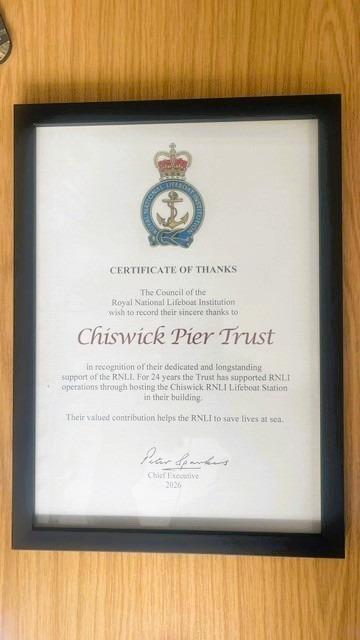
The plaque presented to The Chiswick Pier Trust by the RNLI
As the speeches and presentations concluded, the celebrations continued and guests spread outside to enjoy the balmy evening into what was a perfect riverside gathering and setting. This was Chiswick Pier doing what it does best.

Guests enjoying the evening
So, what will happen at Chiswick Pier now?
Whilst The Chiswick Pier Trust continues fulfilling its charitable remit of providing an active calendar of events, activities and outreach programmes, there is much more to come in early 2027.
Plans are well underway for a new bistro café venue at Chiswick Pier, bringing a unique community hub venue and riverside meeting space designed to be enjoyed by all in the wider Chiswick community.
The outgoing lifeboat crew are already planning to include coffee breaks at their old home on their daily training schedules afloat. Like those offspring who once left home, they often find reason to pop back. Funny that.
But, above all, there is one thing that holds all of this and all of us together – The River Thames. Dependable, accessible, inspirational – Just where would Chiswick be without it?
Shakespeare on Screen season at the Chiswick Cinema
Michael Billington introduces the Shakespeare On Screen season at Chiswick Cinema showing this autumn
‘Shakespeare on Screen’ starts at the Chiswick Cinema Sunday, 30 August
Guest blog by Michael Billington
A couple of years back Chris Parker, chief programmer at the Chiswick Cinema, invited me to host a season of films written by Harold Pinter. It proved a popular success helped by guest appearances from Jeremy Irons and Rupert Everett.
READ ALSO: Jeremy Irons talks about the making of The French Lieutenant’s Woman (1981) at Chiswick Cinema
READ ALSO: Rupert Everett delights audience at Chiswick Cinema
When Chris asked for a follow-up I suggested Shakespeare on Screen which starts this Sunday (30 August) with a showing of Coriolanus directed by and starring Ralph Fiennes and prefaced by a specially recorded interview with the man himself: Mr Fiennes, that is, not Shakespeare.

Ralph Fiennes in Coriolanus (2011) /IMDb
The only problem with a Shakespeare season is the multiplicity of choice. Incredibly, the first attempt to put Shakespeare on screen dates back to 1899 when the camera recorded a scene from Beerbohm Tree’s production of King John.
We haven’t gone back that far but we’ve come up with seven titles that show the amazing range of Shakespeare films. Fiennes’s Coriolanus is itself astonishing: a Roman tragedy set against the background of a modern Balkan war with a cast to die for, including Brian Cox, Vanessa Redgrave and Jessica Chastain.
Michael Billington asks Ralph Fiennes about filming Coriolanus
We follow that on 20 September with a screening of Sir Kenneth Branagh’s Much Ado About Nothing starring himself and Emma Thompson, shot in the ravishingly beautiful Tuscan countryside and arguably the best film of a Shakespeare comedy ever made. Once again we’ll begin the evening with an interview with Sir Ken recorded for the occasion.

Kenneth Branagh and Emma Thompson in Much Ado About Nothing (1993) /IMDb, Metro-Goldwyn-Mayer Studios Inc.
You will find a full list of the films on the Chiswick Cinema website but I hope there is something for all tastes.
Chiswick Cinema – Shakespeare on Screen
We will be showing Roman Polanski’s Macbeth which, like a lot of his work, is about the resonance of evil, and Orson Welles’s Chimes at Midnight in which he himself plays Falstaff, and Sir John Gielgud Henry the Fourth: this is a late Welles masterwork all too rarely seen.

Jon Finch and Francesca Annis in Macbeth (1971) /IMDb
There will also be two Japanese films by the great Akira Kurosawa: Throne of Blood and Ran: the former a thrilling samurai version of Macbeth and the latter a re-imagining of King Lear that, in some ways, makes more sense than the original.

Toshiro Mifune in Throne of Blood (1957) /IMDb
Finally in December comes the 1961 film of West Side Story that sets Romeo and Juliet in the streets of New York and that won ten Oscars.

Rita Moreno, Suzie Kaye, Yvonne Wilder, Maria Henley in West Side Story (1961) /IMDb
I hope the season will show that, while Shakespeare wrote for the stage, he also belongs in the cinema.
Michael Billington, who lives in Chiswick, writes for the Guardian and was its theatre critic from 1971 to 2019. Last year he celebrated 60 years as a critic and he still writes reviews for Country Life and several other publications.
Last year he spoke about his long career at a Media Club session hosted by The Chiswick Calendar at George IV.
READ ALSO: A conversation with Michael Billington
Heirs & Grievances: when life insurance paid for murder

Catherine Flannagan (left) and Margaret Higgins, the ‘Black Widows of Liverpool’, hanged in 1884 for murdering their own family for the insurance money
In the fourth instalment of the series, James Thellusson tells the story of the ‘Black Widows of Liverpool’, and the fraudsters who preyed on Britain’s earliest pension and insurance schemes
Guest blog by James Thellusson
On 17 June 1583, Richard Martin, a London alderman, arranged the world’s first life insurance policy for William Gibbons, a salter. Life insurance was a radical and positive change, which ensured families would receive some inheritance after the death of the family’s breadwinner. The same was true of pensions. On the other hand, these products have also become an incentive to kill or to deceive.
Nothing shamed the Victorian poor more than a pauper’s burial. Paid for by the Parish, a pauper’s funeral meant no service, no gravestone and a shared grave. By the early 19th century, there were over 7,000 burial clubs in the UK designed to help the poor save weekly for a decent funeral.
But not everyone liked burial clubs. In 1848, The Spectator said they were ‘a popular incentive to infanticide… The cost of burying the child ranges from twenty to thirty shillings; the burial clubs allow [up to] five pounds; so that the surplus is a direct premium on the death of a child.’
Parliament held debates with conservative MPs and Peers criticising burial clubs for creating a moral hazard and a temptation for the working class to kill their own children in order to inherit a pathetically small payout from an insurance policy, a temptation which they thought the poor would be unable to resist.
This was sanctimonious class condescension flying in the face of truth. But one case spectacularly showed the fears of The Spectator were not entirely unfounded: the case of the Black Widows of Liverpool.
Catherine and Margaret Flannagan were sisters from Ireland who came to Liverpool after the Great Famine ended in 1852, where they ran a boarding house. Catherine’s son, John Flannagan, lived with them, along with Thomas Higgins and his daughter Mary. Another lodger was Patrick Jennings and his 16-year-old daughter Margaret.
In December 1880, Catherine’s son, John Flannagan, died suddenly. She claimed £71 (roughly £7,500 now) on his life insurance. In October 1882, Margaret Flannagan and Thomas Higgins, her lodger, married. Within months, Thomas’s eight-year-old daughter, Mary, was dead. Then, in January 1883, Margaret Jennings, the daughter of Patrick, the other lodger, died. Three children were dead in two years, all of them fully insured. The neighbours began to gossip.
In September 1883, Thomas Higgins fell ill. He complained of a burning throat, muscle cramps and debilitating diarrhoea. Two days later, Higgins died. The doctor recorded death from dysentery, but Patrick Higgins, Thomas’s brother, was sceptical. His brother was a hod carrier and in good health. Why had he died so quickly?
When Patrick discovered his brother had five burial club policies, he thought he had found the answer. Thomas’s death meant Margaret would ‘earn’ £100, about two years’ wages at the time. Patrick reported his suspicions to the police. With the hearse parked outside ready to take his brother’s dead body to the cemetery, Patrick and the coroner burst into Catherine and Margaret’s home and performed a post-mortem on the dead body as it lay on the kitchen table.
The toxicologist discovered traces of arsenic in Higgins’s organs, and the police found arsenic in Margaret’s pockets. The authorities then exhumed the bodies of John Flannagan, Mary Higgins, and Margaret Jennings and found all three corpses had arsenic in them, too.
Catherine and Margaret were charged on 16 October 1883 with the murder of Thomas Higgins. At the trial, Catherine admitted she knew about the murders but claimed she did not personally administer the poison. She blamed her sister and claimed they were part of a syndicate of local women who murdered others for their burial policy payouts.
Both sisters were hanged together on 3 March 1884, in Kirkdale Prison, while a crowd of 1,000 people waited outside the prison gates. Their cold-hearted calculations were an affront to the Victorian public’s view of femininity and motherhood, who delighted in news reports of the trial.

Kirkdale Gaol, Liverpool, where Catherine Flannagan and Margaret Higgins were hanged in 1884
On 24 October 1642, just after the bloody battle of Edgehill, the Long Parliament introduced payments of up to four shillings a week for the wives of its dead and disabled soldiers, ‘to provide for their families’. This was the first time the state introduced national payments for the families of British soldiers. The plan was morally and politically necessary. But the system for paying soldiers became a long-running fraud and farce in which fraudsters faked the wills and identities of dead soldiers to claim their army pensions.
The scams started just after Charles II commissioned Sir Christopher Wren to build the Royal Hospital Chelsea in 1682, which managed the pension and death payments of the British army, as well as providing shelter for wounded soldiers.

The Royal Hospital Chelsea, built by Sir Christopher Wren, which managed the pensions and death payments of the British army
The hospital’s governance and payments systems were frequently abused. Two types of fraud plagued it: forged claims made by corrupt staff, and fake affidavits used by fraudsters to claim the back pay and pensions of dead soldiers.
The fraud was rampant and hard to police. The Ordinary of Newgate, a record of Newgate prison’s death row inmates, contains army fraudsters like Nicholas Campbell, who was executed for ‘feloniously and falsely making, forging and counterfeiting, and causing and procuring’ a life certificate. Often accomplices were women who flagrantly impersonated the real wives of dead soldiers and robbed them of their pensions. In 1838, a single investigation into dodgy claims in Glasgow secured 21 convictions.
The Royal Navy was no better. When it was unable to pay its wages (which was often), the Royal Navy would issue sailors with ‘tickets’, a form of IOU. This created a market for sailors’ tickets. Technically, this trade was illegal, but sailors’ wives often found themselves desperate to feed their children or pay their rent and were prepared to sell their husbands’ tickets at a discount to intermediaries who would then trade them in and claim the full value.
These traders realised the Navy Pay Office was poorly staffed and the system was open to abuse. As early as 1698, the Admiralty Board admitted that a large number of women were claiming fraudulently to be the executors, creditors or next of kin of dead seamen. By 1757, fraudulent claims on sailors’ back pay and pensions were so widespread that the government made personation a capital offence.
Among the most prolific fraudsters were a mother-and-daughter team, Anne and Leah Lowe. Anne was so infamous that the press nicknamed her ‘The Ticket Monger’. William Rycroft was one of the many sailors who suffered at her hands. In 1692, William went to the Navy Pay Office expecting to claim his back pay, only to find the money was gone. The Navy Pay Office had honoured a forged letter of attorney, and his wages had been paid to Anne Lowe. Forging letters of attorney was a common trick. Anne would add a clause, which made her or an accomplice the sole executor of the sailor’s will. If the sailor died, she would claim their estate, leaving the rightful heirs bereft.
When Anne died in 1694, her daughter, Leah, took up her mother’s mantle. In 1712, the London Gazette described Leah as ‘a notorious Old Offender’ after she was convicted at the Old Bailey for trying to sell the wages of a dead seaman, John Godfrey. Fifteen years later she was still committing the same crime, forging a counterfeit order for the back pay of a dead sailor, William Bar, and ‘persuading Margaret Smith to personate’ his widow and collect the £17 wages he was due. Leah was described as ‘one of those vile Persons cheating and defrauding the Widows of such Seamen as die in the Voyage’, and died in 1729, utterly unrepentant for the distress she had caused.
Next week: forging a will is one thing, but pretending to be the legitimate heir to a noble title requires cunning and a brass neck, as we shall see in the case of the Wagga Wagga butcher, who travelled from Australia claiming to be the long-lost Roger Tichborne, baron and heir to the extensive Tichborne estates in Hampshire
 James Thellusson is a writer living in Chiswick. He is the author of ‘School’s Out: Truants, Troublemakers and Teachers’ Pets’, and has written for The Oldie, The Idler and Management Today. He won the Sandstone Press Prize for Short Fiction. He is writing ‘Heirs & Grievances’, a history of famous feuds and inheritance disputes, from which this series is drawn. His agent is Andrew Lownie. James previously wrote ‘Man in the Middle’ for the Calendar and is published in the recent anthology of cricket poems ‘Catching the Light’.
Horatio Nelson: Fever and Fire returns to the Tabard for five night run

Adam Preston’s one-man show about the naval hero returns to Chiswick after selling out in April, on the back of a Standing Ovation award nomination
Horatio Nelson: Fever and Fire, the one-man show about the naval hero written and performed by Adam Preston, returns to Theatre at the Tabard in Chiswick for five nights from Tuesday 8 September, following a sell-out run at the venue in April.
The play traces Nelson’s early years, the loss of his mother when he was nine and his position as an overlooked “middle child”, and explores how those experiences fed his drive for love and glory. It goes on to cover his early struggles, his battles at sea and his affair with Emma Hamilton.

The critically acclaimed show, boasts costumes by Dougie Hawkes, who won a Primetime Emmy in 2025 for his work on Bridgerton, and a soundscape by BBC sound designer Amanda Priestley.
Preston, who calls himself ‘a self-confessed Nelson obsessive’, said:
“The reaction to the shows at the Tabard in Chiswick was overwhelming. We’ve been nominated for a Standing Ovation award and the reviews were incredible”.
Harry Speirs, writing in London Pub Theatre Magazine, said the show ‘packs plenty of punch whilst maintaining a careful, clever control’ and called it ‘a masterful spectacle.’
Our Simon Thomsett, writing his review for The Chiswick Calendar back in April called it an ‘impressive achievement.
READ ALSO: Horatio Nelson: Fever and Fire – Theatre at the Tabard review
Tickets are available at: Tabard Theatre
Is overconsumption taking over your home?

Sara Butchart is a professional organiser based in Chiswick and the founder of Sorted Sara. If your drawers, cupboards and spare room have been quietly getting out of hand, she has a method for that.
Guest blog by Sara Butchart
Create a calmer, more organised home this autumn
As a Professional Organiser working with clients across London and the South West, I see the effects of overconsumption regularly. It isn’t simply about having too much stuff. It can also be about the habits, emotions and marketing that encourage us to keep buying more.
So, what is overconsumption? Put simply, it’s buying or acquiring more than we can realistically use.
I see two main types in my work.
Physical overconsumption is perhaps the easiest to spot. Many homes contain an impressive supply of cleaning products, toiletries, stationery, medicines and food – often bought because they were on offer or because it seemed sensible to have a spare.
The problem comes when those “spares” become a whole cupboard, shelf or room of their own.
Digital overconsumption is less visible, but can be just as overwhelming. Think about an inbox filled with newsletters, offers and promotional emails, alongside the messages you actually need. I’ve worked with clients who feel so overwhelmed by their inbox that they consider starting an entirely new email account.
Both can leave us with a feeling of “I’ve got too much to deal with.”
So why do we keep buying?
1. Marketing is designed to encourage us to buy
We are surrounded by messages telling us that we need more.
Buy one, get one free. Limited time only. Last chance. Subscribe and save. Free delivery if you spend £50.
Add in the ease of one-click purchasing and it’s remarkably easy to buy something before we’ve stopped to ask ourselves whether we actually need it.
Next time you’re tempted by a bargain, try asking: “Would I buy this if it wasn’t on offer?”
That one question can be surprisingly powerful.
2. Sometimes, having “enough” doesn’t feel like enough
For some people, having a plentiful supply of certain things creates a feeling of security.
Perhaps it’s toilet paper, tins of baked beans, your favourite shampoo or cleaning products. Having a few spares can be perfectly sensible. But when “just in case” becomes a substantial stockpile, it can start taking over your home.
This can sometimes be linked to experiences of hardship, uncertainty or fear of the future. If that’s the case, simply being told to “stop buying” isn’t necessarily the answer. Understanding where that need for security comes from can be much more helpful.
A simple question to try when shopping is: “Do I need this, or will having this simply make me feel safer?”
3. Sometimes we’re shopping for the feeling, not the thing
There’s also the pleasure that can come from finding something, anticipating its arrival and finally receiving it.
For some people, shopping can become a way of lifting their mood, filling time or providing a little excitement – particularly when we’re bored, lonely or having a difficult day.
And I have to admit, even as a Professional Organiser, I love a good shop-up to lift my mood!
I’ve learned to put a few rules in place for myself:
- Never buy anything from bed at night. If I still want it in the morning, I can reconsider.
- Shop from a list. If it’s on the list, there’s a reason I need it.
- Buy gifts for people, not for a hypothetical future occasion. I don’t need a cupboard full of “just in case” presents.
These small rules help me stay in control of my shopping rather than letting shopping control me.
If you’d rather have some help getting started, Sara offers a professional organising service based in Chiswick. As well as working through the sorting and categorising with you, she can advise on storage solutions, help with the trickier decisions, and arrange donation and recycling collection so it’s dealt with on the day.
Club Card members get 10% off and a free 30-minute consultation. You can find her full listing on the Club Card page.
Read more stories on The Chiswick Calendar
See also: Ealing school pays tribute to girl who died alongside family in sea off the coast off Shoreham
See also: Chiswick School celebrates GCSE results above national averages
See all the latest stories: Chiswick Calendar News & Features
 Support The Chiswick Calendar
The Chiswick Calendar CIC is a community resource. Please support us by buying us the equivalent of a monthly cup of coffee (or more, if you insist). Click here to support us.We publish a weekly newsletter and update the website with local news and information daily. We are editorially independent.
To subscribe to the weekly newsletter, go here.
Before We Forget – Bush Theatre review

Zarmeeneh Khan and Priscilla Oshinibosi
A funny, sharp satire on a tech company’s promise to let you relive your best memories
In Before We Forget, which played for just a few performances last week at the Bush Theatre, American Tech arrives in the UK in the form of Recall, a concept promising “a better relationship with your memories”: a sort of memory archiving service that allows its customers to instantly relive chosen moments from their past.
In a fragmented narrative, resembling perhaps how we experience memory itself, we see employees of Recall recruiting customers, hero worshipping their clearly loopy CEO, debating emerging moral dilemmas relating to the technology they control and managing their clients as they revisit cherished moments from their past.

Shekinah Singh and Meg Gillard
Woven into this is a memory of a budding stop/start romance which just won’t work out properly without some modification, presenting something of an ethical challenge.
Meanwhile a renegade group of dissenting young people plot to try and derail the project, recognising it for the terrifying overreach it represents.
If this all sounds a bit po-faced, then fear not, not only is it very funny in places, but there is a real energy and bite to the satire on show. The Recall promise to introduce customers to “the purest version” of themselves is set against a plea to trust the tech, after all, it can help “to find what’s inside” and, of course, there will be “access for all.”

Ethan Simm
Performed by an exuberant ensemble, Before We Forget was created by the 18-25 Young Company at the Bush, under the skilful organising eye of Director Amber Ruby who made full use of the whole of the Holloway Theatre stage, gleefully breaking the fourth wall at times; at others isolating individuals at significant, often emotional moments, while other company members lurk in the shadows.
There’s nonsense spoken about temporal lobes and cerebral cortexes as the Recall employees work themselves up until they are “super-excited”, trying to pull us in, chanting the company mantra of “Recall now, Recall forever” and insisting that this idea is “not just going global, it’s going celestial.”
At times the scarily smiley evangelists for Recall work on us as spectators, imploring us to trust them; the young woman performing in front of the section of the audience I sat in had a full-on Book of Mormon smile that actually forced a nervous laugh from me, the kind you do during a horror film to relieve the tension (me scared? Nah.)
The obvious influence is Dark Mirror, along with any number of dystopian sci-fi stories warning us of unrestrained Big Tech overreach.
This is a show full of ideas, eager to entertain every bit as much as to make you stop and think and it’s worthy of a longer run or a revival. In light of the arguably worrying influence that Big Tech has over our own Government, Before We Forget offers a warning and a call to resistance from a talented young company, that many will find heartening. There’s hope for humanity yet.
All photos from the production credited to Harry Elletson
 Simon Thomsett has worked in the professional theatre for a number of years. He started out as a stage manager and technician then became a venue director and producer, notably at the Hackney Empire, Fairfield Halls and most recently the New Victoria Theatre in Woking.
He now works as a consultant and on some small scale producing projects. He is a Chiswick resident and a passionate advocate for great theatre.
Read more stories on The Chiswick Calendar
See also: Hounslow councillors get a pay rise
See also: Chiswick School celebrates outstanding talent with a host of celebrities at Performing Arts Awards
See all the latest stories: Chiswick Calendar News & Features
Support The Chiswick Calendar
The Chiswick Calendar CIC is a community resource. Please support us by buying us the equivalent of a monthly cup of coffee (or more, if you insist). Click here to support us.We publish a weekly newsletter and update the website with local news and information daily. We are editorially independent.
To subscribe to the weekly newsletter, go here.
Man appears in court accused of fatally stabbing woman and injuring her daughter in Askew Rd attack
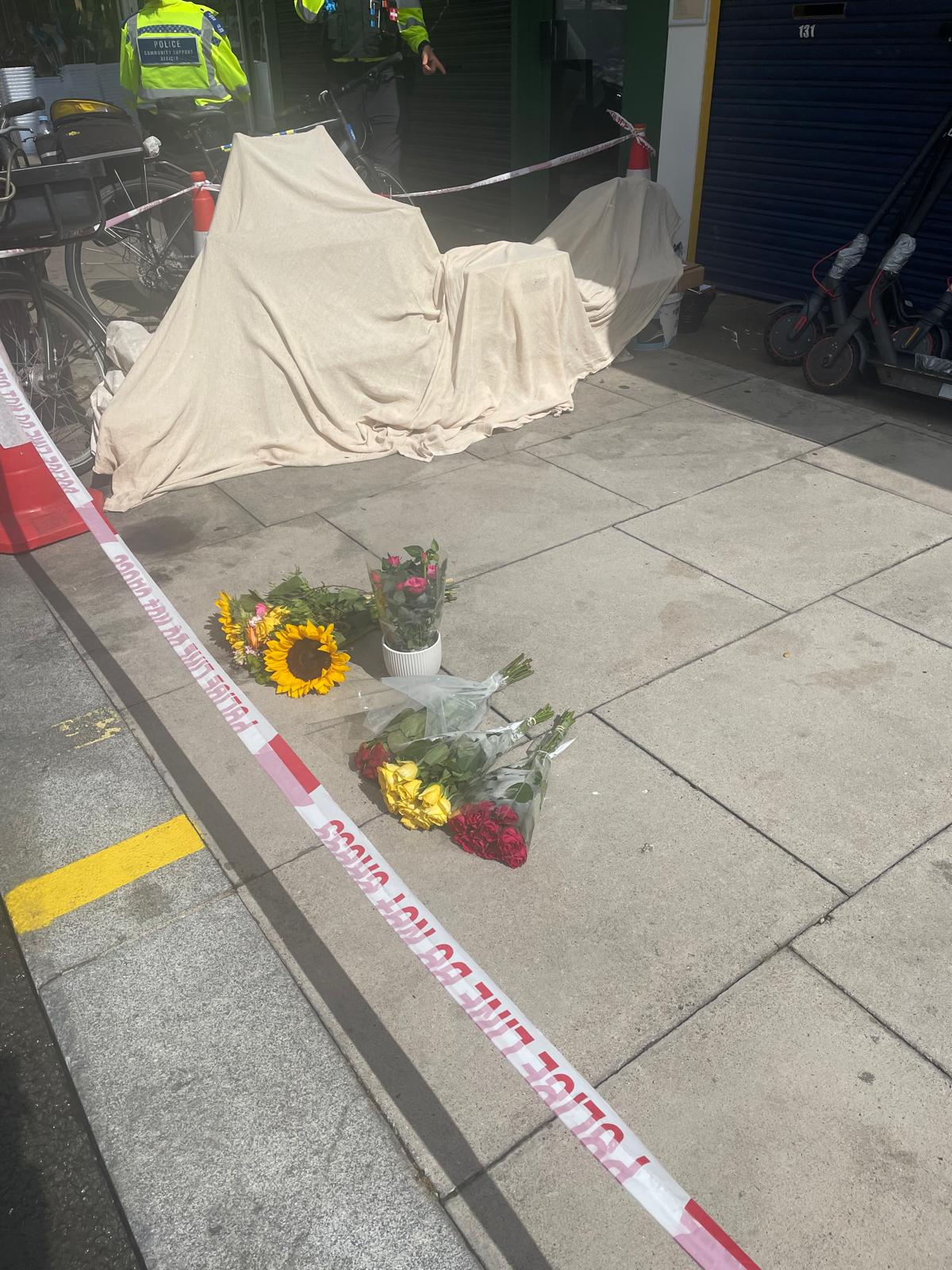
Crime scene in Askew Road, Tuesday 18 August; photograph Steve Anderson
Court heard 48-year-old man fatally stabbed Samantha Turner 70 times and injured her daughter as she tried to stop ‘murderous attack’
Alan Dore, 48, appeared at the Old Bailey on Monday, charged with murder and attempted murder.
Dore was accused of killing Samantha Turner, 52, in her home on Askew Road on 18 August. He had been in a relationship with Turner for about a year and lived nearby.
When her daughter, Keeley Turner, 32, tried to stop the ‘murderous attack’, the court heard, Dore stabbed her in the abdomen and back.
Keeley Turner remains in hospital, although her injuries are not thought to be life-threatening.
The court heard that Keeley Turner had been upstairs at the home on Askew Road when she heard her mother’s screams and went downstairs. Prosecutor Philip McGhee said that when she tried to stop the defendant, he stabbed her.
McGhee said the allegations in the case were of a ‘murderous attack’ with a knife in a ‘domestic setting’.
She called 999 at 8.19 am and told the police: ‘Hurry up man, he’s going to kill her.’
Samantha Turner was pronounced dead at the scene at 8.54 am. Dore was arrested in a bedroom of the property.
McGhee told the court a post-mortem examination identified around 70 sharp-force injuries, which were allegedly inflicted with ‘severe force’.
Judge Simon Mayo KC set a schedule for the case. There will be a plea hearing on 9 November and a provisional three-week trial from 17 May next year. Dore was remanded into custody.
Paws on patrol at London Waterloo

Dogs Riley, Buster and Flo started regular patrols at London Waterloo this month as part of new safety initiative
The Paw Patrol is in fact on a roll at London Waterloo as dog patrols have become part of security teams for the first time.
Cocker Spaniels, Riley and Buster and Labrador Flo were introduced earlier this month as part of a three month trial to strengthen security at the London station.
Riley, 11, Buster, nine, and Flo, 10 have joined the South Western Railway and Network Rail Wessex team to provide extra reassurance for customers. They are specially trained to patrol large areas, detect hidden threats and apprehend subjects.
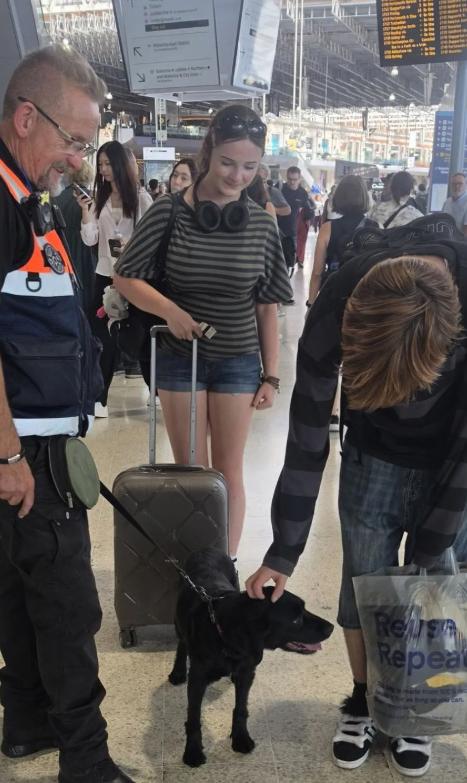
SWR, Commuters meeting Riley
Dan Harrison, the station manager confirmed the introduction of the dogs wasn’t linked to a specific threat, and was for the purpose of providing a visual deterrent and to support customers.
Harrison said: “Security needs constant innovation and we’re taking positive steps to reassure our customers that we take their safety very seriously.
“In the same way, we recently equipped all our colleagues with new hi-vis tabards to make them more easily identifiable to customers in the station who might need their help,” he added.
South Western Railway said London Waterloo is Britain’s first major station to introduce dog patrols as part of a wider programme to keep customers and those working at the station safe.
Along with the new four legged additions to the security teams, other recent measures include equipping colleagues with body-worn cameras to tackle assaults and abuse and upgraded CCTV across the Network.
South Western Railway said this will be Riley, Buster, and Flo’s last deployment before they retire.
So next time you go to London Waterloo, you may notice the new (furry) additions to the station security team.
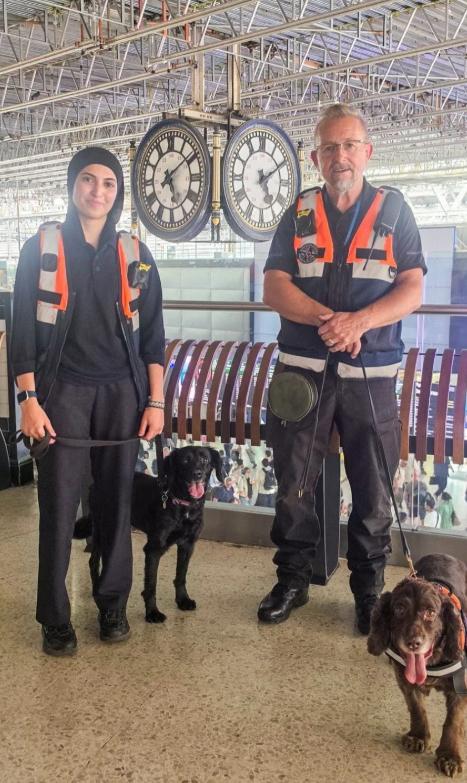
SWR, Colleagues with the dogs and their new hi-vis tabards
South Ealing Cemetery’s buried secrets are brought to life

Designed by local architect Charles Jones in 1861, the chapels have been out of use for 10 years
This 21-acre cemetery on the boundary of Ealing and Hounslow is being reimagined as a unique leisure space for residents
If you think hanging out in a graveyard is creepy, then think again. South Ealing Cemetery – formerly known as Ealing and Old Brentford Cemetery – is one of the borough’s most exciting green spaces to get a makeover.
Back in 2024, Ealing Council transformed a golf course into a 49-acre park, but they also entered into a less widely reported collaboration with the charity Ealing Parks Foundation (EPF) to reimagine a 156-year-old cemetery in South Ealing Road into a community space.
Projects such as these are part of Ealing’s long-term strategy to boost biodiversity in urban areas and provide more usable green space for its residents. They also showcase how important the work of friends groups and charities can be in delivering these innovative ideas.

The history of occupants in the cemetery has been researched by EPF volunteers
A significant funding bid
This month, the cemetery project is being taken to the next level as the team at EPF put the final details together for a significant funding bid.
Before residents recoil in horror at cobwebby tombstones and a thriving bat population, they should know that the broad-based plans for the site are all very respectful and most locals have agreed that these picturesque graveyards are the perfect place for improving mental well-being.
The cemetery will not lose sight of its original purpose as a resting place for the dignitaries of Brentford as well as the founders of its football club, many of whom are buried here.
There is even a proposal for a football-based walking trail – still in discussion with Brentford Supporters Club – that reinforces the charity’s belief that green spaces are for everyone – not just birders and volunteer gardeners.

The grand Gothic-style entrance to South Ealing Cemetery
The Grade-II Listed buildings lend themselves to community spaces
Interestingly, Brentford’s elite citizens created for themselves quite a grand Gothic-style entrance for their cemetery which features a central porte-cochère with clock and belfry, flanked by a south chapel (Church of England) and a north chapel (Non-conformist), constructed of ragstone with limestone dressings.
A key aim of the project is to save these Grade-II Listed chapels, which are on Historic England’s Heritage at Risk register, and put these at the centre of a wider strategy to open up the cemetery to residents.
“Our hope is to bring the chapels back as community spaces,” says co-chair of the Ealing Parks Foundation, Paul Carter. “The Grade-II Listed buildings lend themselves to workshops, exhibitions, music recitals and more.”
To that end, volunteers have already been carrying out basic maintenance including the restoration of electricity and the servicing of the clock and its pulley system.
At the end of August, Ealing Parks Foundation will submit a funding bid to Historic England after working closely with architects, council surveyors and community groups to create a proposal for phase one of renovating the historic chapels. Ealing Council has also committed to contribute.

The formerly dark and forbidding main avenue has now been transformed
Improved sightlines
A lot of work has already been done on the grounds, which featured dark foliage and hidden areas that had, in recent years, made the cemetery a magnet for drinkers and drug dealers.
“The first priority was to make the space safe and welcoming,” says Paul. “Our early work was about improving sightlines and crown-lifting trees and shrubs, rendering it hard for visitors to get up to anything nefarious.
“The main avenue had huge yew trees and we’ve reduced their height, but without losing the higgledy piggledy nature of the cemetery or its wildness.”
From the beginning, Ealing Parks Foundation has always run regular volunteer sessions to maintain the grounds, which are posted in advance on their website.
READ MORE: For information on upcoming events, click here.

Selected memorials have been cleaned
Expert help on making memorials safe
Starting in the Victorian section (at the South Ealing Road entrance), residents have planted bulbs and sown wildflower seeds, cleaned bird boxes and installed new ones, cut back vegetation and cleaned selected memorials after researching the history of the occupants.
Volunteers have even enjoyed a training session from the Habitats and Heritage charity on how to assess the condition and safety of memorials.
“Any site maintenance that requires heavy machinery, the council will do,” explains Paul. “It has definitely been a co-operative initiative.”


Biodiversity has been boosted in the oldest part of the cemetery
Butterflies and bugs are now thriving
Two years into the project, the results are inspiring. After EPF initiated a new mowing regime that allowed the old cemetery to retain its long grass and wildflowers, participants at a butterfly event recorded how much more biodiverse the historic area is than the new cemetery where the grass is cut short.
To offer the public an insight into their work, EPF is holding three guided walks as part of London Open House on Sunday 20 September that will allow visitors to connect with heritage or nature.
READ MORE: Book tickets for London Open House tours here.
To coincide with Ealing Climate Week (19 to 27 September), EPF will also be holding two planting days on 22 and 23 September where volunteers can learn about drought-tolerant plants and participate in the creation of new climate-resilient schemes for the front beds and the war memorial.
READ MORE: about the 2026 programme for Ealing Climate Week.


Participants in a bat walk, led by Sean McCormack, enjoy tracking the mammals with detectors
Bats are the celebrities of the cemetery
Previous walks have been very successful with a guided bat walk by Dr Sean McCormack of the Ealing Wildlife Group attracting 120 participants. What could be more atmospheric than wandering at dusk in the grounds of this ancient cemetery with its lush trees and meandering paths?
“As a small charity, EPF is limited in the number of events it can run itself and has teamed up with the brilliant park leaders at Boston Manor Park in order to offer more opportunities for people to volunteer or enjoy a range of activities at South Ealing Cemetery,” says Paul.
Not all of the activities are nature-based and new ideas for welcoming residents to the grounds have been very successful.
“We’ve already hosted a couple of Arts and Crafts markets which were run by the Wandering Fox Market. Feedback from visitors and stallholders was very positive and we plan for three more markets this year including Halloween and Christmas,” says Paul.

Over 100 participants attended the bat walk at South Ealing Cemetery
Visitors are flocking to the events
“Since we’ve starting using Eventbrite, we’ve even had visitors from north, east and south London.”
A cemetery might not be the most obvious place to go Christmas shopping, but why not. If the extensive grounds are otherwise under-utilised, it would be a waste not to enjoy this lovely, historic setting.
The main entrance to South Ealing Cemetery is on South Ealing Road, W5 4X2. It can be reached on the E3 or 65 bus. The nearest tube station is South Ealing (Piccadilly Line).
Lineup of authors announced for Chiswick Book Festival 2026 Local Authors Showcase
Local Chiswick authors taking part in this year’s Local Authors Showcase at the Chiswick Book Festival
Well-known local personalities unveil their books
Some well-known local figures will be taking part in the Local Authors’ night at this year’s Chiswick Book Festival.
There are so many people who live or work in Chiswick who have written books that each year the Festival gives Chiswick locals their own dedicated night when they are given a couple of minutes each, strictly kept to time, to make an elevator pitch for the book they’ve written to a packed audience in the Boston Room of George IV.
It’s great fun and the tickets sell out early.
Rev. Martine Oborne
This year’s event on Wednesday 9 September will see vicar of St Michael’s Church, Elmwood Road, Rev. Martine Oborne launch her novel The Trials of Jessica Lovegood, which tells the story of a woman vicar whose bishop doesn’t believe women should be priests.
READ ALSO: The Trials of Jessica Lovegood – new book by Rev. Martine Oborne review and interivew
It will also see The Chiswick Calendar’s theatre reviewer Simon Thomsett introducing his second novel The Angry Widow.
READ ALSO: The Angry Widow – a new book by Chiswick author Simon Thomsett
Simon Thomsett
Simon worked for many years in professional theatre, initially as a stage manager and technician, then as a venue director and producer, notably at the Hackney Empire, Fairfield Halls and most recently the New Victoria Theatre in Woking.
READ ALSO: Chiswick Calendar theatre reviews
He now works as a consultant and writes novels and theatre reviews in between working on small scale production projects. His second novel follows the aftermath of a horrifying crime through the eyes of two people directly involved, including the victim’s widow, whose ordinary suburban life is about to change for ever.
Two other recognisable faces from the Tabard Theatre who have new books out are Nick Bromley, associate director of the theatre, and actor Tim Marriott. The Tabard has gained a reputation for encouraging new writing – evidently not only of plays.
 Nick Bromley
Nick’s book Cry Havoc is set on New Year’s Eve 1919, when a naive young British soldier in Germany embarks on a series of farcical, dangerous and deadly adventures.
Nick was for many years a stage manager in West End theatres before turning his hand to directing and writing. Two plays you may remember he has directed at the Tabard are Delinquent Dad and The Last Laugh.
READ ALSO: Working with Alec Guinness, Ralph Richardson and Elaine Paige – Nick Bromley
He has appeared at the Local Authors night before to talk about his book Stage Ghosts and Haunted Theatres, a collection of tales gleaned from working in West End theatres.
READ ALSO: Stage Ghosts and Haunted Theatres
 Tim Marriott
 played the manager in the delightfully uncomfortable dialogue The Appraisal – a conversation between a senior manager, and a direct report who manages a team of people under him.
He also played Monty, the anxious father of a British girl on the day of her marriage to an American boy, in The Special Relationship.
Tim’s book Revelation is set in Patmos, the final ferry stop in the Dodecanese, which forms the backdrop to a modern journey of reflection and change.
 Dr Karen Liebreich, MBE
Another well-known personality around Chiswick is Director of the environmental campaign group Abundance London Dr Karen Liebreich, who will be promoting Abundance’s book on the fruity history of Chiswick: Chiswick Fruit Timeline: A History in Apples and Pears.
The book, which will be on sale also at Apple Day run by Abundance London on Saturday 5 September, tells Chiswick’s history as a centre of market gardening and home of what became the Royal Horticultural Society, from the birth of the Chelsea Flower Show, to new varieties of apples and pears that became standard fruits for the world.
READ ALSO: Chiswick’s Apple day – Saturday 5 September
READ ALSO: From orchards to Apple Day: Chiswick’s fruity history
The local authors presenting their books at the Local Authors’ Showcase will be presenting both fiction and non-fiction work, aimed at a range of ages.

Rebecca Thornton
Rebecca Thornton is a novelist and journalist who also runs an online advertising business. Her work has been published in Prospect magazine, the Daily Mail, the Jewish News, and the Sunday People and she has reported from Kosovo and the Middle East.
She will be promoting Faculty of Liars, her fourth novel. A former WHSmith Fresh Talent author, Faculty of Liars is written under the pen-name RJ Heber; it takes readers deep inside the polished halls of an elite New England institution — a place where prestige is everything, secrets are currency, and reputation is protected at any cost.
Best selling Young Adult fiction
 Dan Batchelor
Parents at Grove Park Primary School will recognise Dan Batchelor, a Chiswick primary schoolteacher, who has released the second instalment of his Young Adult sci-fi trilogy, Jack Palmer II: The Resistance, about a young boy thrust into the chaos of an alien invasion.
He talked to The Chiswick Calendar about the success of the trilogy earlier this year.
READ ALSO: Chiswick teacher who battled dyslexia as a child has second Young Adult Fiction book published
A New Order has been a best seller for publisher Cranthorpe Millner, earning praise for its fast-paced, engaging narrative about a young boy navigating the terrifying reality of an alien invasion.

Alwyn Hamilton
Alwyn Hamilton will also be known to parents, as when she is not writing she has worked at weekends in the children’s section of Waterstones bookshop in Chiswick.
Her fantasy thriller The Notorious Virtues is also aimed at young adults, though I thoroughly enjoyed reading it.
READ ALSO: The Notorious Virtues – A new book from Chiswick’s best-selling author Alwyn Hamilton
The Notorious Virtues is page turner, with likeable protagonists in a complicated murder mystery plot that pulls the reader into its magical world of knights and charms. It is set in the same world as her best-selling trilogy Rebel of the Sands.
When she spoke to The Chiswick Calendar last year about her success, she was about to go on a tour the United States promoting the books. Published by Penguin in the US and Faber here, she was on the New York Times best-selling authors list; her books have been translated into 14 languages; and she has travelled as far afield as Singapore and Brazil to speak about them.

This year’s books by local authors
Children’s books
Two authors will be talking about their books for children:
Mariesa Dulak, a primary school librarian, will be promoting her latest book The Ice Cream Crocodile, a rhyming tale full of circus fun about celebrating difference and overcoming prejudice.
West End & TV actor and producer Matt Barber will be introducing Nora the Nerdie Neanderthal, which has yet to be published and will have its first public airing at the Showcase.
 History and memoir
 History and memoir
Sue Elliott will be introducing her history of the newly opened ‘Trent Park House of Secrets’ in Enfield. The house was originally built in the 1780s as part of King George III’s estate, and rebuilt in the 1890s in Victorian style before an extensive refurbishment by Sir Philip Sassoon in the 1920s, transforming it into a luxury weekend retreat for hosting his fashionable and famous guests at elegant parties.
It became a ‘House of Secrets’ because in the winter of 1939-40 it was transformed into a state of the art surveillance centre.
Sue has written seven works of social and oral history; as a student she lived at Trent House in the 1970s and her fascination with the building led her to explore its history in Trent Park House: A Century of Secrets.
Hillie Marshall will be talking about Playing Cupid, her funny and honest memoir of building her Dinner Dates introduction agency. Hillie has been a radiographer, singer, pantomime performer, theatre impresario and relationship counsellor before becoming an author.
See You, Sam by Jack Waddington is a brother’s diary to the sibling he lost to Duchenne muscular dystrophy, exploring grief, disability, and the silence that follows loss.
Restoring La Casa Rotta by Professor Sir Robert Lechler, Professor Emeritus at King’s College London is ‘a tale of Umbrian Adventures’ about acquiring a ruined remote farmhouse in central Italy.
Non-fiction
 Non-fiction
Togetherness: Symbiosis and the Hidden Story of Life’s Greatest Collaborations by Rowan Hooper, New Scientist’s Podcast Editor, is an exploration of how co-operation between species in the natural world has been key to survival:
‘For the history of life on Earth is much more than a story of competition. The natural world has been forged and sustained by small miracles of co-operation between animals and plants, insects and fungi, fish and bacteria – these partnerships are ubiquitous, lifelong and are an essential guide for a better future’.
The Financial Times Guide to Business Ethics by Pablo Lloyd goes inside businesses to reveal why some fall short and how others lead the way.
Quiver, don’t Quake: How Creativity Can Embrace AI, by The Bookseller columnist Nadim Sadek reframes AI as a creative collaborator, liberating our creativity.
Building The Inquiring Mind: A journey through the history of thinking by Denys W Graham takes readers on a fascinating journey through early theology, philosophy, neuroscience and psychology.
The Parent Carer: A Survival and Advocacy Handbook for Raising Children With Additional Needs/SEND is a practical handbook by award-winning, disability-inclusion campaigner Natalie Hay.
Life Keeps Lifeing is an embodiment of poetry and life by Christopher Jarvis, a community development officer for Hounslow Council.
The Joy of Games by Sam Stephens offers engaging games to reconnect with friends and family – ‘the ultimate escape from the endless screen scroll’,
The Local Authors’ Showcase will be hosted this year by new presenter, Capital Xtra DJ Jojo Silva.
Tickets available here: Local Authors’ Showcase
Polish Centre says that proposed parking changes will destroy its events

POSK is nearly 50 years old but its history stretches back further
Over 800 objectors call on Hammersmith & Fulham Council to reconsider the proposed parking restrictions that could decimate footfall at the Polish Social and Cultural Association
In response to a plan to change existing parking outside the historic cultural hub in King Street, the Polish Social and Cultural Association (POSK) has launched a petition for the proposal to be stopped, claiming it will “decimate our footfall”.
It all began with residents in Zone L asking for changes to the current parking restrictions, blaming significant, increased pressure on spaces for locals and their guests.
Hammersmith & Fulham Council (LBHF) then launched a consultation, which expires at 5pm on 18 September, on whether to introduce seven-day parking controls and a maximum stay of two hours.
READ MORE: Zone L consultation for residents and businesses
Currently parking controls operate between 9am to 5pm Monday to Friday and there are no maximum stay restrictions.
This means that local residents have found commuters using Ravenscourt Park tube station to access Central London have taken parking places for up to eight hours. Non-resident commuters and shoppers can also currently park for free in evenings and at weekends.
For the Polish Social and Cultural Association (POSK), which hosts a wide variety of events including film, theatre, concerts, exhibitions and lectures, accessible parking is key to the success of their events.


A rich programme of events makes the Polish Centre a popular destination
Visitors come from far and wide
In their view, the new parking restrictions would threaten the future of their busy centre which is home to multiple community organisations – including meetings of the Chiswick Arts Group – and attracts many visitors from outside the borough.
The centre is home to a historic library that attracts scholars from around the world and welcomes jazz fans travelling from across southern England.
Wiktor Moszczynski of POSK believes that this is “particularly malicious” to elderly patrons who can’t manage the steep staircase at Ravenscourt Park Station and would mean that visitors are forced to miss the end of a performance rather than face a penalty as many events run for more than two hours.
In addition to older people, families with young children and those with mobility needs will be disproportionately affected.
A petition asks for cultural value to be considered
In response to the consultation, POSK has urged the council to recognise the centre’s important cultural and community role and ensure that parking regulations do not create unnecessary barriers to visitors attending events.
It argues that any additional controls should target commercial vehicles rather than cultural visitors.
READ MORE: Protect Access to Cultural Events at POSK

Zone L is mostly residential and close to Ravenscourt Park
Displacement from other zones to blame
Opponents of the new restrictions believe that the council is to blame for the pressure on parking spaces, citing displacement from Zone A and Zone M due to new extended controls which push vehicle parking into Zone L.
One former Chiswick resident and POSK patron, who has been attending the centre for 40 years, says:
“The spillover is the result of restrictions in Hammersmith town centre that keep pushing the problem further out.”
In its survey LBHF acknowledges that controls in three streets – Weltje Road, Rivercourt Road and Cromwell Avenue – are issues that have been raised. The council argues that the proposed parking restrictions would bring Zone L in line with other zones.
Chiswick’s Apple day – Saturday 5 September

Abundance London’s Apple Day
Juice making fun on offer outside Chiswick Library from 1.00 – 3.00 pm on Saturday 5 September
Apple Day on Saturday 5 September offers the people of Chiswick the opportunity to help turn this year’s harvest into juice – a free and fun activity, with free fresh juice at the end of it.
Abundance London have been collecting Chiswick’s apples since its inception 15 years ago, involving schools in the harvesting and making sure surplus fruit does not go to waste.
READ ALSO: Chiswick Apple Day 2025 picture gallery
From 1.00 pm – 3.00 pm, outside Chiswick Library, you can join in feeding the apple scratter. It smashes up the fruit before the pulp is added to the apple press. And don’t worry, no prior knowledge of an apple scratter will be required.
If you fancy having a go at using an apple press, as you might have done in the Middle Ages, and the scratter, which is state of the art, the juice making stand will be in action.
The last ten days of fruit collections will be saved for pressing so the juice making can commence.
As well as all that excitement, organisers Abundance London say there will be many other activities on offer to get stuck into. From apple bobbing to painting ‘insect pebbles’, there will be a lot on offer.

Children apple bobbing at Abundance London’s Apple Day last year
Prizes for the longest apple peel will be up for grabs – so start practising your peeling!
Handsewn lavender bags created by the Make and Mend team are back by popular demand.
The Mayor of Hounslow Councillor Ranjit Gill will be attending at at 2.00 pm to see everything Apple Day has to offer.
As Chiswick was built on orchards and the remnants still persist in individual gardens, we have prolific and diverse apple crops.
If you would like to know more about Chiswick’s ‘fruitful’ history, The Chiswick Fruit Timeline book – A History in Apples and Pears will be on sale for five pounds. All proceeds will go to Abundance since ‘very kind people and local businesses’ have sponsored the printing.

The Chiswick Fruit Timeline book – A History in Apples and Pears
Abundance London would like to thank Jenny & Chris Blishen, Louise Kaye, Julian Tanner, Jeremy Vine, and the George IV pub, and Terra Futura Fragrance for their support.
READ ALSO: From orchards to Apple Day: Chiswick’s fruity history
Apple Day is at Chiswick Library on Saturday 5 September.

Ealing school pays tribute to girl who died alongside family in sea off the coast off Shoreham
Ellen Wilkinson School for Girls “deeply saddened” by the loss of 14 year old Sara El-Khawas
 Ellen Wilkinson School for Girls “deeply saddened” by the loss of 14 year old Sara El-Khawas
Sara El-Khawas
Sara El-Khawas died alongside her parents after getting into difficulty in the water off the coast of Shoreham on Sea in West Sussex. Her school, in Ealing, has paid tribute to the “well-liked, sweet girl”.
Sara, her mother and father, Zeina Alayn (37) and Hassan El-Khawas (55), and her little sister Saja (6) went into the water near Shoreham Fort on Tuesday 18 August, according to Sussex police. The family are believed to have travelled to Shoreham from London for the day.
The Palestinian Forum said the family were British citizens of Palestinian origin, with roots in the Rashidieh refugee camp in Lebanon.
Police, paramedics and coastguard crews pulled four people from the water. Sara and her parents were pronounced dead at the scene, while Sara’s six year old sister Saja was hospitalised and died on Friday. It is believed to be a tragic accident with no third party involvement.
Flowers were left near the RNLI station on Kingston Beach in Shoreham on Thursday morning.
The Ellen Wilkinson School for Girls put a statement on its website that said:
“It is with great sadness that we share the news that our Year 8 student, Sara, has died following a tragic incident during the school holidays.
“Sara was a sweet girl, well-liked by staff and students, and she will be greatly missed.”
The statement acknowledged the news will be “deeply upsetting for many students, families and staff”. The school further asked for the family’s privacy to be “respected as they come to terms with this loss”.
Rachel Kruger, head teacher of the Ealing school, said:
“We are deeply saddened by this, our thoughts are with her family, friends and all those affected.
“Our focus is now on supporting staff and students who have been affected by this.”
Chiswick School celebrates GCSE results above national averages
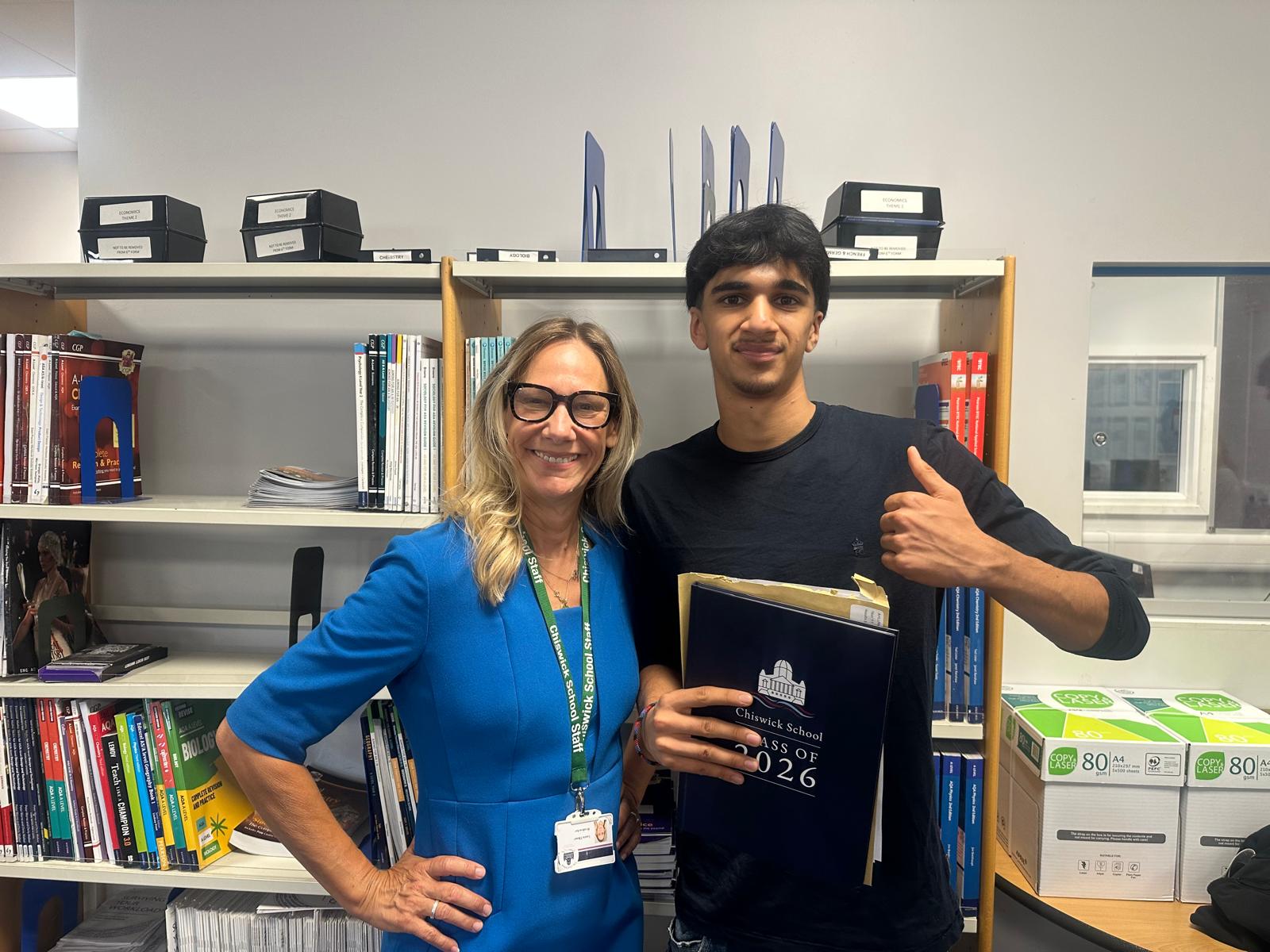
Head teacher Laura Ellener with Dhyaan, whose results were 9,9,9,9,9,8,8,8,6,6
Chiswick School celebrates ‘another year of outstanding academic success’
Chiswick School is celebrating ‘another year of outstanding academic success’, with student attainment at GCSE once again surpassing national averages.
‘Students demonstrated impressive achievements across a wide range of subjects’, a spokeswoman for the school said, ‘reflecting the school’s dedication to high academic standards’.
Nearly a third of student entries (30%) were awarded top marks at grades 9–7. More than half of students in History, Science and Religious Studies achieved Grades 9–7 and the school is expecting its Maths and English results to exceed national averages.
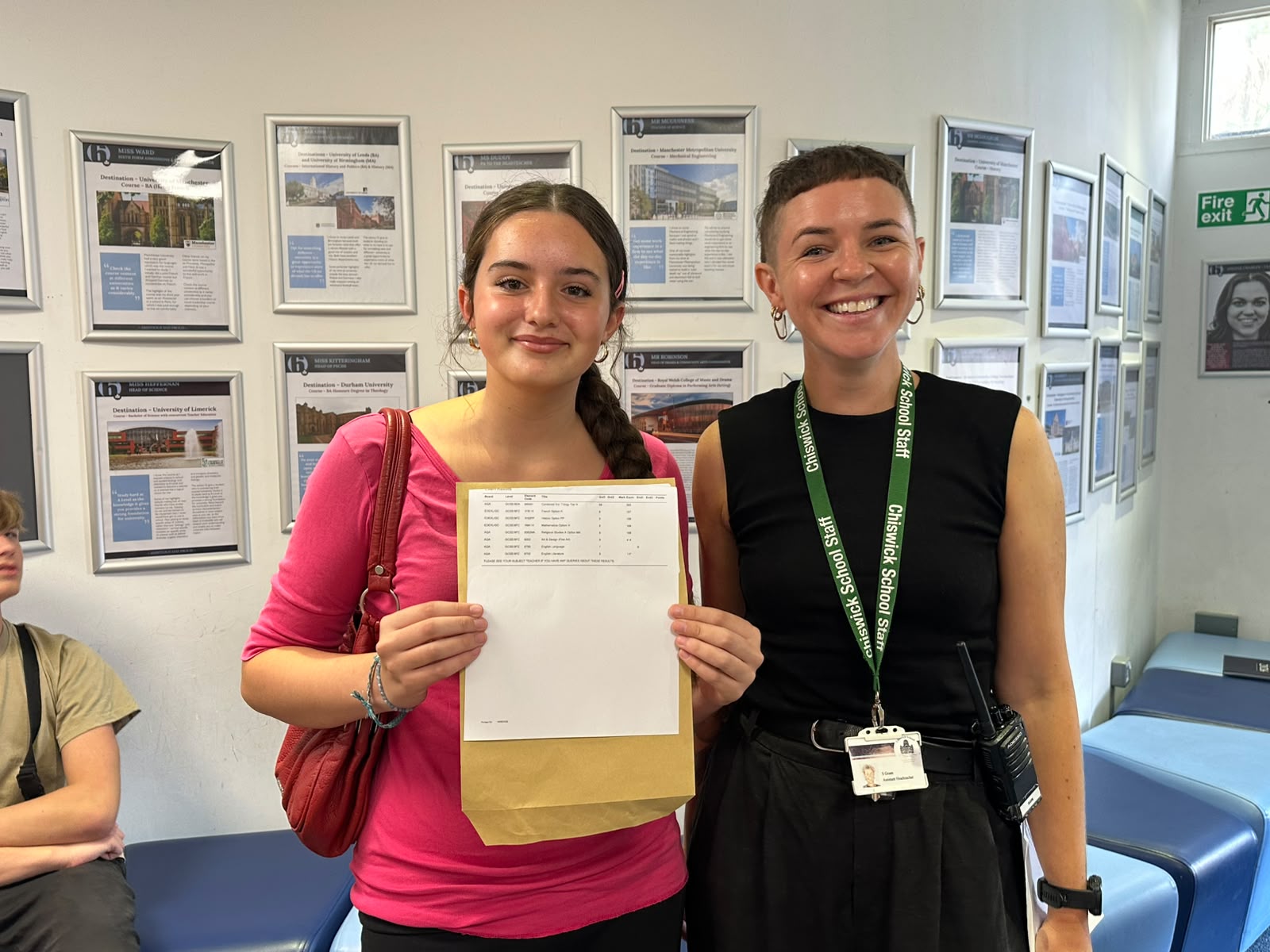
Sura (L), whose results were 9, 9, 9, 9, 8, 8, 8, 8, 7
Last week they were celebrating ‘fantastic’ A Level results and many of the students will be going into the sixth form to continue their academic journey, as it continues to grow in both size and reputation.
READ ALSO: Chiswick School celebrates ‘exceptional performance’ at A Level
The school prides itself in being genuinely inclusive.
‘Alongside these scholarly successes’, they say, ‘Chiswick School continues to foster the broader personal development of its students within a supportive, inclusive, and enriching environment’.
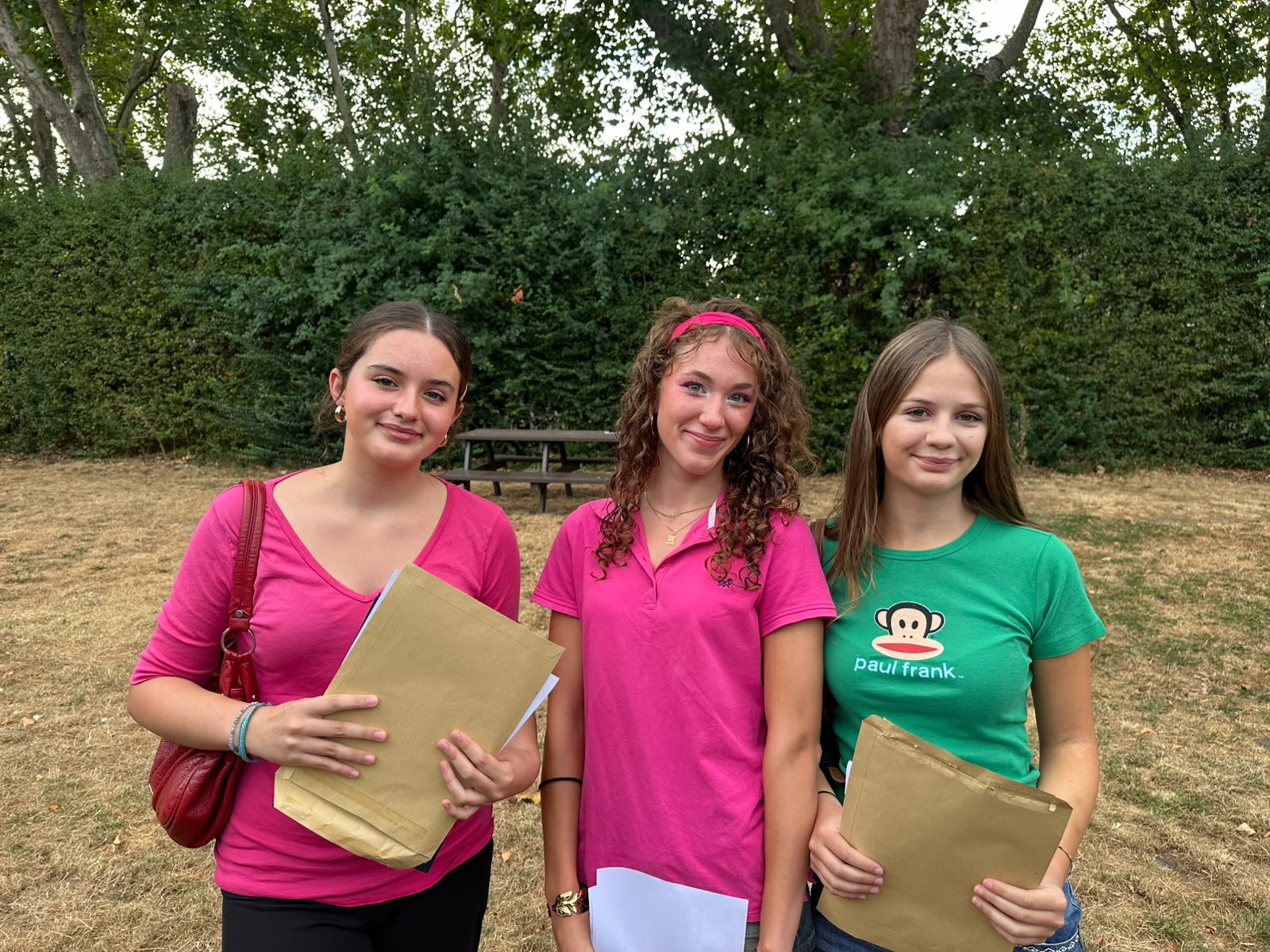
Sura and friends celebrating their results
Last year Ofsted inspectors praised the ‘exceptional level of care and support’ provided to students, as well as the ‘curiosity and enthusiasm’ shown by students in lessons.
READ ALSO: Chiswick School receives a glowing report from Ofsted
The Office of Qualifications and Examinations Regulation describes the results nationally as ‘stable overall in comparison with those in 2025’.
Overall outcomes at grade 7 and above are almost identical to 2025 (21.8% of results compared with 21.7% in 2025), and outcomes at grade 4 and above are just 0.1 percentage point down on 2025, at 67.0%.
Like last year, more results were issued in London at grade 4 and above (71.7%) and grade 7 and above (28.6%) than in any other region.
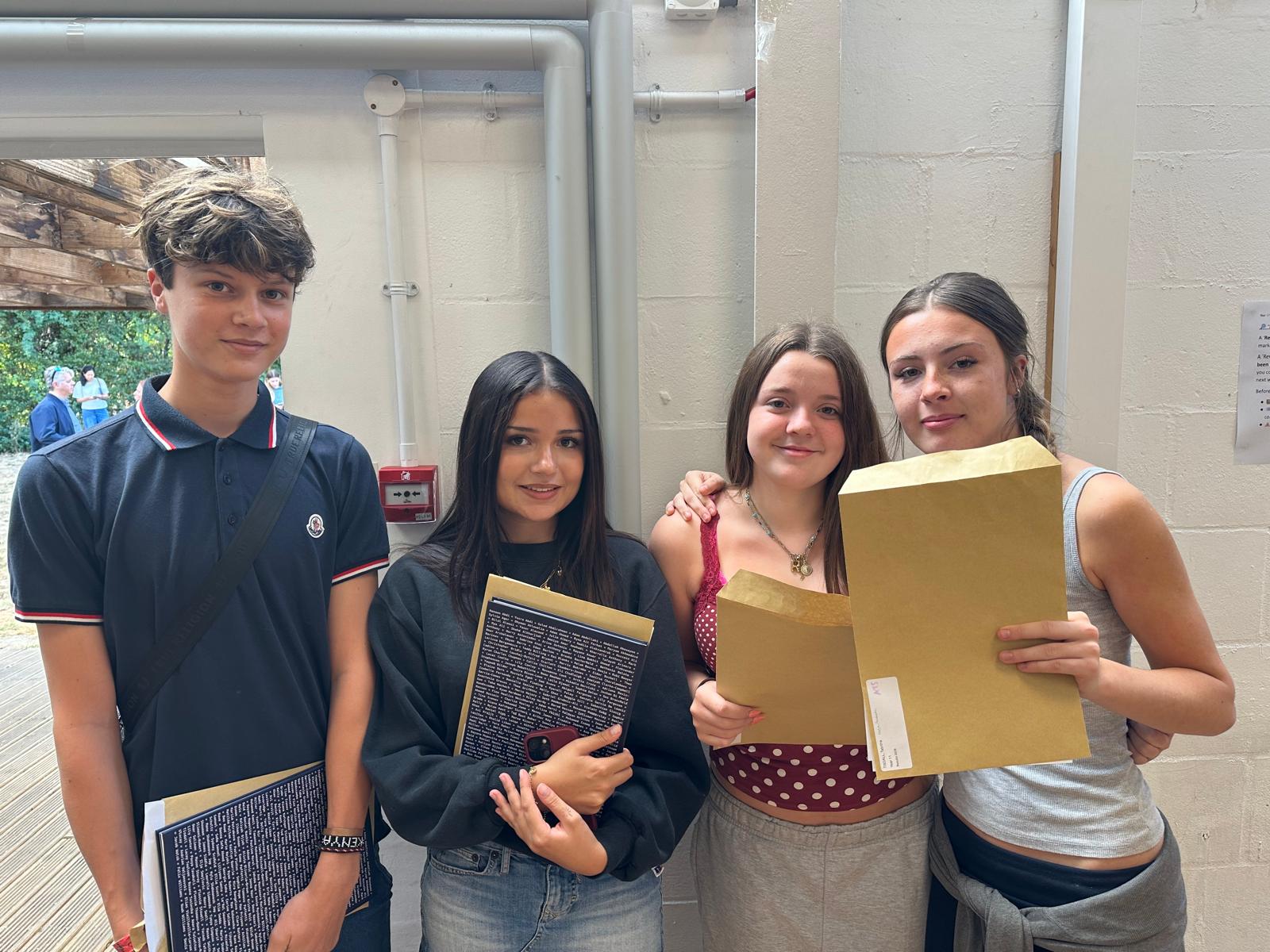
Chiswick students happy with their results
Man dies in car smash near Chiswick Roundabout
Chiswick Roundabout, Thursday 20 August
Car driver arrested on suspicion of dangerous driving after passenger dies in collision with bus
One man has died and two others were taken to hospital in the early hours of Thursday morning (20 August) after a car collided with a bus on Gunnersbury Avenue, just north of Chiswick Roundabout.
Police closed the A406 in both directions as paramedics treated three people at the scene. London Ambulance Service, who received the first call at 12.18 am, dispatched ambulance crews, paramedics in fast-response cars, an incident response officer and other specialists. The first paramedic arrived in under seven minutes.
The Metropolitan Police confirmed the passenger of the car, a 38-year-old man, was pronounced dead at the scene despite the paramedics’ best efforts.
The car driver, a 24-year-old man, was taken to hospital. Police say his injuries are not life-threatening or life-changing, though he remains in hospital for treatment. He has been arrested on suspicion of causing death by dangerous driving.
The bus driver, a 61-year-old man, received minor injuries and was also taken to hospital.
The North Circular was closed until 10.00 am while police examined the scene.
They are appealing for witnesses, CCTV or dashcam footage and have asked anyone with information to contact them on 101, quoting CAD141/20AUG.
Chiswick boy’s stolen bike returned after BackPedal goes after thief

Technology is key to retrieving a stolen bike
A Gunnersbury teenager, who was given a bike for his 13th birthday, feared it was lost for ever until his dad called upon a specialist recoverer
In normal circumstances BackPedal, who run a theft recovery scheme for bikes (backed up by insurance), work only for clients who’ve had the foresight to pay for their state-of-the art tracker to be installed on a bicycle.
Known for their astonishing record of retrieving 80 per cent of the bikes they protect, BackPedal often look after expensive cargo bikes, e-bikes and models typically worth over £750. You can find more about BackPedal, at their website here: BackPedal
A thirteen-year-old from Gunnersbury didn’t have theft recovery insurance when his bike was stolen at Westfield. Nor did he have much chance of recovering his much-loved bike because fewer than two per cent of thieves are caught.

The teenager on the Specialized model that attracted the thief’s attention
The victim of an opportunistic thief
He did have a high-quality D-lock but instead chained his bike up with a friend’s using his mate’s combination lock. The opportunistic thief had no trouble detaching the new higher-value bike from the other and the boys’ attempts to obtain CCTV footage from Westfield’s customer service proved futile.
“I had put an Apple AirTag on it,” said the teenager’s father, Ed Saper, who also cycles.
“Unfortunately, the tracker hadn’t worked all day – it relies on Bluetooth and is quite short range – but the next morning it started pinging.”
The thief, who was only half a mile away, had taken the stolen bike out for a ride and cycled around west London before returning to the same address – an indicator that the bike might be at the location for a while.
Getting a bike back is tricky
But how to get the bike back? Police are already inundated with tales of woe of lost phones that people say are ‘in that building somewhere’. Even a well-resourced police force cannot cope with theft – whether phones or bikes – on the scale that happens in big cities just because technology allows us that information.
Increasingly, there is a case for tracking and retrieval to be in the hands of specialist operators, who can work independently, or in some cases involve the police.

BackPedal operate in cities but also in rural areas
Highly trained retrieval experts are needed
“I wasn’t a customer of BackPedal,” said Ed Saper. ‘I had looked at their services though, so I got in contact.”
“Normally we just don’t have resources to help non-customers” said co-founder of BackPedal Richard White, “because we’re busy recovering our client’s bikes, but on this occasion, we assessed the information, we had an agent in the vicinity, and decided let’s do it.”
In this case, they had to rely on the AirTag signal.
“AirTags are interesting technology,” explained Richard, “but they are not designed specifically for the recovery of bikes. You don’t know when they’re going to ping and they’ve got anti-stalking safeguards so the thief will be alerted that their phone, or one near them, is being used as a transmitter.”
An exact location must be pinpointed
“With our GPS tracker, we can control when it’s going to ping and we also have custom beacons that help us pinpoint the exact location on the ground.
“Using our beacons, we’ve even got bikes back from the 42nd floor of a block of flats. We’ll send our recovery agent up a high-rise building one floor at a time.”
Fortunately, the Westfield thief didn’t notice that the AirTag was on the seat post of the bike.
BackPedal was able to locate the thief, have a conversation and return the bike to the teenager whereupon the family immediately signed up for their retrieval services for the future.
“It’s a real hassle to lose a bike,” said Ed. “Even if you do get a payout from a [traditional] insurance company, you find yourself without a bike. My son uses his bike daily to go to school.”
READ MORE: bikes stolen on the streets of Chiswick for sale in Moscow
Cleverly concealed GPS trackers are used
So far BackPedal, who have been operating since 2022, have recovered over 1,000 bikes at last count, using GPS trackers and highly trained recovery agents.
Their secret is having a tracker that is hidden to the eyes of even the most experienced thief.
“We have over 60 designs of casings,” said Richard. “They can be hidden in the components on a bicycle or in everyday accessories. Of course, bike designs vary so having designs that fit on every bike is a tough problem to crack.”


Operatives are trained to handle tricky scenarios
How a recovery works
Confronting a thief is not just about courage (though not for the fainthearted) but more about skill and experience: BackPedal’s operatives are highly practiced in extricating a bike and some agents have clocked up 300+ returned bikes.
“When our recovery agents turn up they don’t say ‘you’ve got a stolen bike’ nor do they criticise as they don’t want to escalate the situation,” explained Richard.
The objective is simply to retrieve their client’s property and not to hand someone over to the police.
“If you’ve caught a thief at home, they are very vulnerable and acutely aware that – if the police did get called – there might be an investigation into what else they’re doing. Invariably they hand over that stolen bike.”
A calm and respectful approach
“Sometimes you get thrown into the deep end,” said veteran recovery agent Bilal. “Nothing teaches you better than being under pressure.”
“Our agents are very competent,” said Richard. “If a member of the public had gone to retrieve their own bike, they would be full of adrenaline, but our agents are calm, cool-headed and have access to all the information.”
In this scenario, the AirTag was helpful, but it may not have been, so Ed and his son were extremely lucky. Even with knowledge of where the bike was, they would not have been advised to retrieve the bike themselves but were able to do so safely with a trained recovery agent.
If the teenager had hoped that his bike lock folly would go unnoticed, then he hadn’t reckoned on the intense interest in BackPedal’s retrieval service. As well as being told to the Chiswick Calendar, the tale was retold on BBC Radio Two’s Jeremy Vine show by his dad and the co-founder of BackPedal. And the thief – if he was listening – hopefully won’t try that again in a hurry!
Public warned they will be fined for fly tipping at Acton recycling site
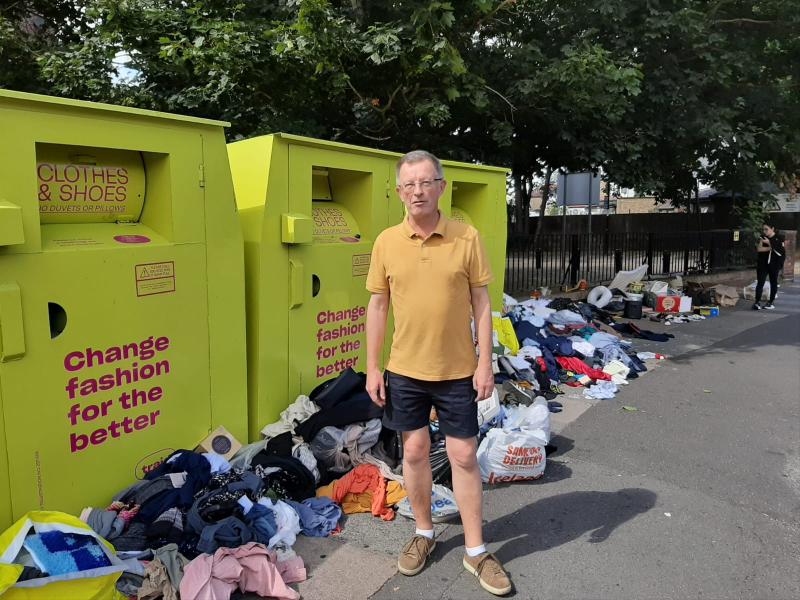
Ealing council has put down £1,000 fine notices for fly tipping after public misuse Traid textile banks
At the textile bins on Bromyard Avenue in Acton, intended only for collection of textiles for reuse as second hand clothes, the public have been fly tipping all kinds of materials that are not textiles.
Sofas, tyres, mattresses, and a pallet of bricks are among the items which have been dumped around the textile bins.
Traid, a charity retailer which collects and sells second hand clothes, has worked with several London councils for 26 years, collecting clothes and shoes. A spokesperson for Traid has said they have never experienced these levels of fly tipping.
The charity collects textiles from the Bromyard site on behalf of the London Borough of Ealing. Now the Council has spray painted notices on the pavement with the warning: “Fly tipping £1000 fine”, in an effort to stop people from doing this.
However, Ealing councillor Andrew Steed thinks the Council needs to be doing more. The Liberal Democrat councillor told The Chiswick Calendar: “I think the message from Ealing Council needs to be much stronger – there needs to be more, bigger signage stressing that environmental crimes are being committed and that fines will be imposed of £1000.”

One of the notices from Ealing council
Beside the rubbish which is just being dumped, the bins are being used a great deal for the desired purpose. Traid have increased the number of days they empty the bins in order to keep up with the amount of textiles being dropped there.
The charity said they were originally collecting three days a week, on Monday, Wednesday and Friday. They added a weekend day and as of this month, have been collecting daily.
It is irritating if you try to recycle responsibly, load up the car and arrive to find recycling bins full to overflowing, but Traid say they are keeping on top of things. They confirmed that over a 30 day period from 14 July the bins were only at capacity once.
Some residents have called for the instillation of cameras to make sure that the collections are frequent enough.
A spokesperson from Traid said:
“It is a shame that the misbehaviour of some impacts so badly on the goodwill actions of the majority within the community”.
Man charged with murder in connection with Askew Road stabbing
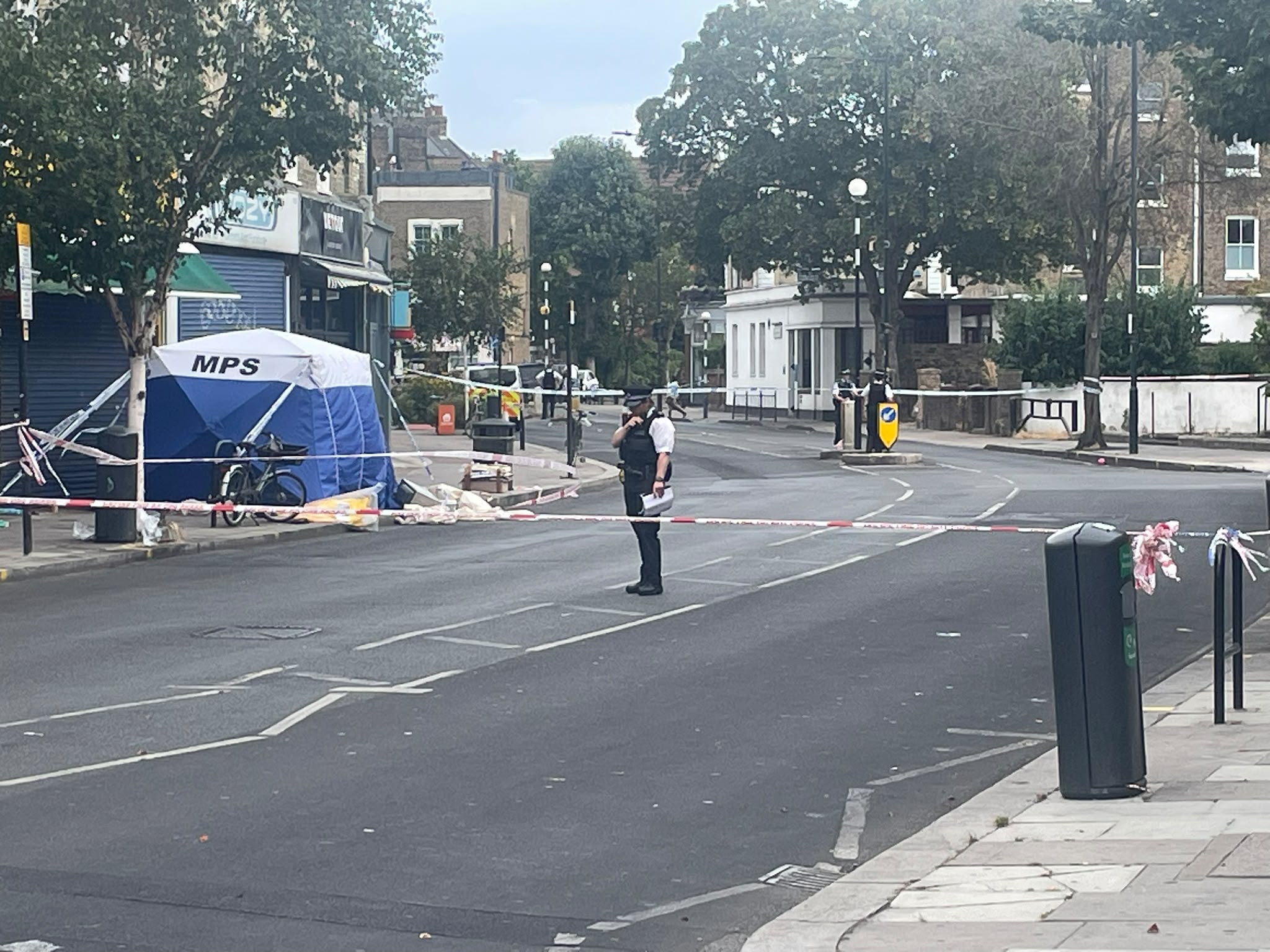
Police in investigation in Askew Road; photograph Steve Anderson
Murdered woman named as Samantha Turner
A man has been charged with murder following the death of a 52-year-old woman in Askew Road on Tuesday morning.
Officers were called at 08.19 on Tuesday 18 August, to an address on Askew Road following reports of a stabbing. A 52 year old woman was pronounced dead at the scene despite the best efforts of emergency services.
She has now been named by police as Samantha Turner.
A second woman, aged 32, suffered non-life threatening stab injuries. She remains in hospital and continues to be assessed.
The police closed a section of Askew Road, which is on the border of Chiswick and Shepherd’s Bush, on Tuesday and kept it closed all day while they began their investigation. A man was arrested at the scene.
Alan Dore, 48, of Askew Crescent, Shepherds Bush, was charged on Wednesday 19 August with murder and attempted murder.
He will appear at Hendon Magistrates’ Court on Thursday, 20 August.
Chiswick Carers Cafe offers moral and practical support for carers
A monthly drop in on Saturdays for unpaid carers
Being the carer for a family member, neighbour or friend can be quite an isolating experience.
With that in mind Hounslow Council is organising drop in sessions – the Carers’ Cafe – once a month in the lounge bar at Chiswick Cinema so people can swap stories with other carers in a situation similar to themselves, make friends and talk to advisers who know what benefits and other help might be available to them.
The next one will be on Saturday 12 September from 11.00 am – 1.00 pm.
Chiswick has a high number of unpaid carers – typically people in their fifteis and sixties looking after elderly parents or children with mental health or addiction problems, or in their seventies looking after partners with long term illnesses such as dementia or Parkinsons.
In the 2021 carer census there were 773 unpaid carers in Hounslow’s three Chiswick wards in the 50 – 64 age bracket, 592 in the 35 – 49 age group and 299 in the 65 – 74 age group. Remarkably there were 41 unpaid carers over the age of 85 and 382 under the age of 35.
Children and young people who care for relatives are offered support by Brentford FC’s Community Sports Trust.
Monthly drop-in at Chiswick Cinema
Nadia Atiq manages the very small team whose job it is to provide information, advice & specialist services for adult social care in LB Hounslow. She told The Chiswick Calendar they set up the ‘Carers Cafe’ monthly drop-in a year ago.
More friendly and accessible than having to go on a website and book an appointment at council offices at the other end of the borough, since April the sessions, on the second Saturday of the month, have been held in the lounge bar of Chiswick Cinema.
All her team, herself included, have experienced being unpaid carers themselves. The idea is that people can go, with or without the person they are caring for, to somewhere that is local, pleasant to spent time in, and wheelchair accessible, where they can meet people who are facing some of the same issues.
In this informal setting carers can either mix and mingle, make friends and seek advice, or they can just relax and have a coffee. Sometimes they organise activities, she told me, but there is no pressure to take part.
They have a Whatsapp channel and a newsletter, Nadia told us, in addition to the basic information for carers on the Council website.
Trying to find out what state benefits are available is foreign territory for many people who find themselves caring for a dependent in later life. Tips on navigating the system is exactly the kind of help they are able to give.
Typically Chiswick’s carers are ‘self-funding’ – professional types who are used to fending for themselves who may not feel comfortable reaching out for help.
‘’You guys kept us carers going throughout winter, while everyone else paused their events, carers had somewhere they could go”
Nadia gave me an example of a carer who looks after her daughter who has a learning disability and Autism.
‘When she first started attending the Carer Cafes, she expressed wanting to leave her job as her employer would not allow her to take time off to attend to her daughter’s needs, which she said she needed once every few months for hospital appointments.
‘The Carers Service informed her about the Carers Leave Act 2023 and supported her to use it when speaking to her employer. She is still in work and feels more comfortable with requesting leave to support with her caring role.
‘She now also supports other carers and people with Autism who attend support groups in knowing about the services available to them’.
She appreciated being able to come to the monthly drop in sessions in Chiswick because it was local. and informal:
‘’You guys kept us carers going throughout winter, while everyone else paused their events, carers had somewhere they could go”.
Another carer, Mahesh, looks after his wife who has cancer. He also has two children in secondary school whom he takes care of.
‘He attended the Carer Café and wanted to discuss his situation in detail. He was appreciative of the fact that there was space to have a confidential discussion away from the group. He also commented ‘’thank you for being that listening ear I needed. Thank you for being where you will say you will be and for following up when I need extra help.’
‘He said he has learned a lot on his caring journey and wants to support other carers who are at the beginning of their journey. He encourages all carers to attend events where they can speak to trusted Carers Advisers, as well as meet other carers who share some of the same experiences.
During Carers Week 2026, M attended one of the events where he was introduced to the manager of the Young Carers Project run by Brentford Community Football Club Trust to ensure his children were supported as young carers as well.

A survey to improve support for carers and awards for inspirational carers
Nadia’s team is currently carrying out a survey and are looking for carers who have had experience of a Carers Assessment through Hounslow Social Work Teams and want to share their experiences to help improve formal support for carers.
“They can also attend a focus group in September if they wish to share their views in person – comments and views expressed will remain confidential unless carers are happy to have their names included.
“Our new Principal Social Worker is passionate about improving the Council’s offer for unpaid carers and will be working with me to help implement changes according to themes identified from the views and experiences that unpaid Carers share with us”.
They are also looking for nominations for the Hounslow Carer Awards so people are able to share their appreciation for those who are usually unsung heroes. The nine categories include: ‘Inspirational Carer of the Year – An unpaid carer who has inspired you or others’, and ‘Light in Someone’s Life Award – An unpaid carer who brightens up your day!’