
A Site of Special Scientific Interest right on our doorstep in west London

Image: Paddleboarding on Thames by Kew Bridge; Active 360
Discover our local SSSI with Active 360 Natural History paddleboarding tours
We have a Site of Special Scientific Interest (SSSI) on our doorstep in Chiswick. I have lived here for more than 30 years and not known that until now.
An SSSI is a site designated by the Wildlife and Countryside Act (1981) as one of the finest sites for wildlife and natural features. Typically they are in wild and windswept places, like the Isle of Man, providing habitats which support rare and endangered species and spectacular natural features, so west London does not scream eligibility.
‘Our’ SSSI is the water meadows at Syon House, one kilometre of river frontage, with little creeks created by the movement of the water, accessible only from the river, which is a breeding ground for all sorts of little fish. Marine biologist Wanda Bodnar goes there regularly, and what’s more she takes trips to see it, by paddleboard.
“Fish can go and hide from predators, bigger fish, and feed. It’s ‘special’ because, like a coral reef or a mangrove, it’s an intertidal meadow with different types of vegetation which creates a habitat for smaller fish.”
A paddleboard glides over the surface of the water without disturbing the fish, which include Roach, Smelt and Dace.

Image: The watermeadows at Syon Park; Active 360
Huge diversity of fish species in the River Thames
The tidal Thames is home to around 125 different species of fish, Wanda told The Chiswick Calendar. Not necessarily all of them all at once, but that many species have been recorded in the river recently.
“I’d say at any given time there are probably 40-45 different species present. The whole of the tidal Thames is an estuary, and estuaries are nurseries for small fish. We have fewer and fewer breeding grounds, which impacts the fish stock, so the water meadows are really important.
“What we are looking at here is how it would have looked in Roman times. It is the only place on the tidal Thames which had remained untouched by human development.”
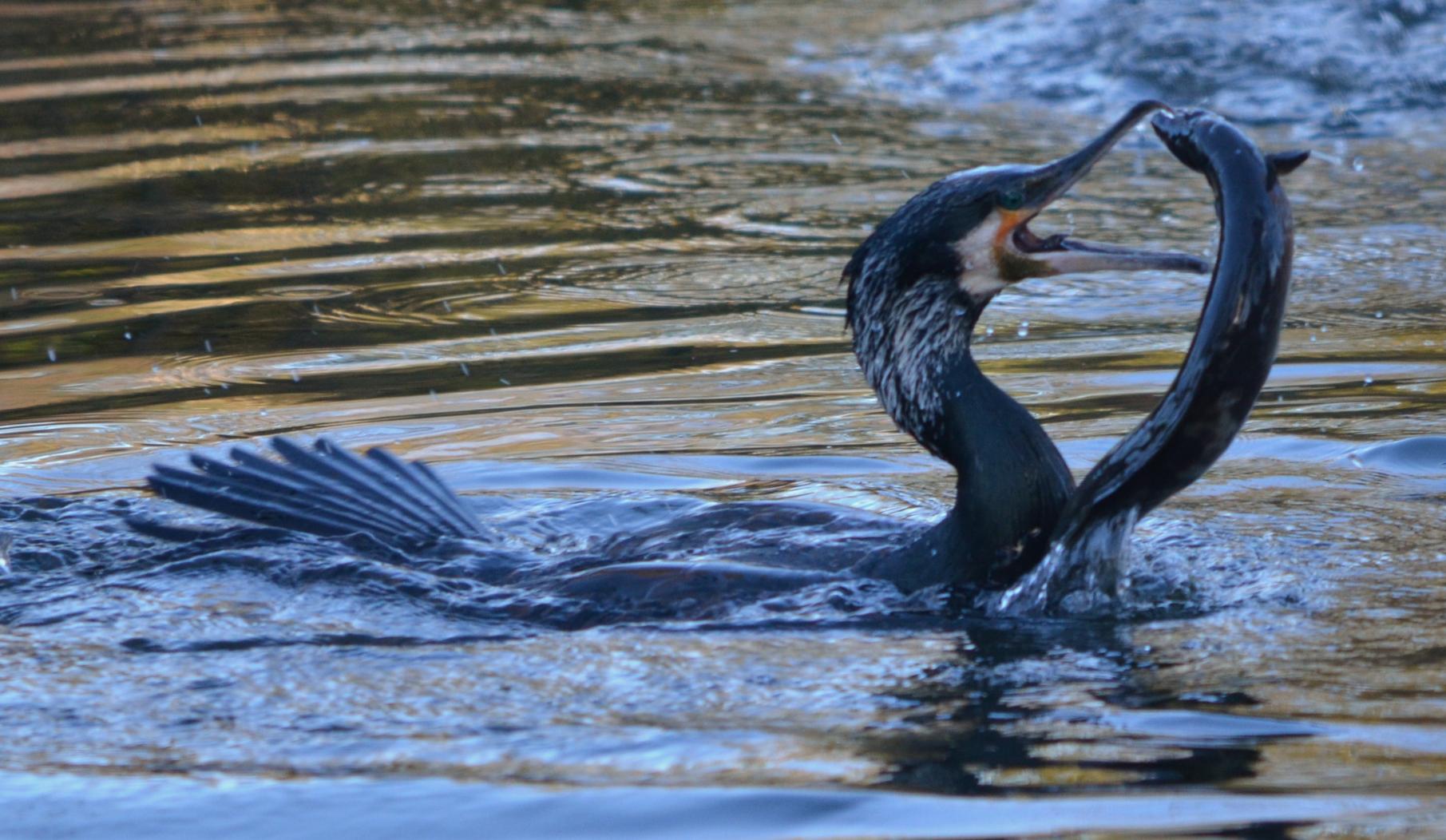
Image: A cormorant catching an eel; Photograph by Lorraine Conterio
Recovery since the river was pronouced ‘biologically dead’ in 1957
Wanda has a Masters degree in Marine Science and when she is not showing people around our bit of the Thames by paddleboard, she is working at the Thames Estuary Partnership, identifying places around the estuary where habitats can be protected for wildlife.
Her speciality is fish migration. Eels, which were so plentiful in medieval England that the Thames was reputedly black with them at certain times, have diminished substantially, but are still in the river. You tend to see them when a cormorant or a heron catches one.
“There used to be literally millions of eels. In medieval times 50% the fish mass was eels. We don’t know why European eels are declining. They spawn in the Sargasso Sea in the Southern Caribbean and take the Gulf Stream to Northern Europe.
“They come for the freshwater habitats and can live in the river for 30 years, then go back to the Sargasso Sea to spawn and die. Maybe it’s because of changes to the Gulf Stream with climate change that is causing the population to decline.”
The Thames was pronounced biologically dead in 1957. There were no fish in the river between Kew and Gravesend, the result of the ‘big stink’ of the 19th century, pollution from industrialisation, the effluent from the increasing population, and the damage caused by wartime bombing on the capital’s sewer system.

Image: Fishing competition at Strand on the Green during Tidefest; Photograph Anna Kunst
In the decades since then the environmental measures put in place have paid dividends. The first fish back were eels and flounder. Now the river is now teeming with fish, so much so that we have a seal population of 4,000 between here and the North Sea, around 800 of them Harbour seals, the rest Grey seals.
“There are seal colonies on the sandbanks downstream, and we see the odd individual this far upstream who is more adventurous, and perhaps more hungry, coming up to feed.”
There has also been a common dolphin spotted recently at Hammersmith.
“He shouldn’t really be here, he was probably lost,” said Wanda.
Video: Common dolphin in the River Thames at Hammersmith, August 2024; Active 360
Nursery for Seabass
Active 360 has produced a very attractive fold out leaflet to accompany their tours, with good quality pictures of the plants, fish, invertebrates and birds you can expect to see. It surprised me that Seabass was on the list.
“The Thames is one of the biggest Seabass nurseries in the southern part of England. They weren’t around in such high numbers 30 years ago. They prefer warmer water, so it’s a sign the Thames is getting warmer. We don’t really know why there is now such diversity in the fish stock, but the diversity of breeds is driven by climate, salinity, water temperature and the availability of habitats.”
And is all this progress in the health of the river under threat from the sewage that regularly overflows into the river after heavy rainfall?
“Yes, and no” she says. “The main problem for fish is the lack of oxygen. Bacteria decomposing the sewage takes up the oxygen, but that matters more when the water is not moving.”
It matters to Active 360 also because scummy water can be off-putting to would-be customers.
“We don’t go out if there’s been a spillage” she said.
That is not why the river is brown, by the way. She is often asked why the river is brown on her tours, and it is because it’s tidal. The movement of the water stirs up the mud, so it is in constant suspension. The Romans called it ‘Tamesis’, meaning ‘dark one’, so it was brown then too. The river is so tidal, even this far up, that the difference between high and low tides at spring tides can be as much as seven metres.

Image: Paddleboarding on Thames at Isleworth; Active 360
Active 360 application for a grant for testing the water at Kew
Paul Hyman, environmentalist and owner of Active 360 paddleboarding at Kew Bridge points out that the advantage of the tidal Thames is that it is tidal – whatever is put into the river will eventually wash out to sea, so while there are definitely days when you should not go in the river, that is not the case most of the time.
He is hoping to secure a grant for water testing kits to use at Kew Bridge and has asked other local water sports clubs to take part in testing.
“I’m planning to bid for funding to buy some water testing kits which would detect E. coli in the river. My thinking is we could regularly test and publish the information, which I hope would give a real picture of water quality in the river. This could help us make more informed decisions on whether the river is safe to use on any given day.
“It may help to counterbalance some of the alarmist reporting of publications like Time Out which in April called the Thames ‘toxic’.”

Image: Tidefest; Photograph Anna Kunst
Paul is also looking forward to the opening of the Tideway tunnel next year.
“The tunnel will begin cleaning up the river from October and be fully operational next summer, so in theory the results should be increasingly better.”
Wanda and a colleague take it in turns to take two hour trips upriver from Kew Bridge, past Kew Gardens and Syon House and Isleworth, and down river to just beyond Chiswick Bridge most weekends, depending on tides, weather conditions and bookings. Suitable for complete novices at paddleboarding as well as those with experience.
Book here for Active 360 Natural History paddleboarding tours: Natural History tours
Active 360 is a member of The Chiswick Calendar’s Club Card scheme. They offer a discount on weekday classes and courses, and the discount also applies to their weekend Natural History tours – for details see their Club Card page:
Read more stories on The Chiswick Calendar
See also: Woman dies in collision with lorry on Gunnersbury Avenue
See also: Pasta Evangelists to open in Chiswick
See all the latest stories: Chiswick Calendar News & Features
 Support The Chiswick Calendar
The Chiswick Calendar CIC is a community resource. Please support us by buying us the equivalent of a monthly cup of coffee (or more, if you insist). Click here to support us.We publish a weekly newsletter and update the website with local news and information daily. We are editorially independent.
To subscribe to the weekly newsletter, go here.


