
Are recklessly ridden and badly parked e-bikes soon to be a thing of the past?

Rental e-bikes are frequently left on the pavement or in a gutter
As new legislation promises Transport for London the power to licence and regulate dockless e-bikes, the London Assembly’s Transport Committee met TfL’s executives, a London Councils representative and rental bike operators to explore a pan-London model that will work for everyone
E-bikes are growing so fast in popularity that public fury can hardly keep pace as vehicles are increasingly left strewn in public places or ridden on pavements, forcing pedestrians to step into the road.
Irresponsible riders are a hazard for parents with prams, small children, people with sight loss, mobility aid users and older citizens though any one of us might be caught unawares by these speedy silent bikes.
Collisions of rentals are on the rise
A rising proportion of cycle collisions involve cycle hire, increasing from two per cent in 2017 to 18 per cent in 2025.
Injuries can be life changing. Jane Ouartsi, who was hit by a Lime bike ridden by a ten-year-old boy in a public square, spent 36 days in hospital and had to learn to walk again after three operations.
Another pedestrian, Sandy Peters, had her face smashed after a collision with a speeding Forest Bike, leaving her with PTSD and a £10,000 bill for dental work.
Responsibility is with the rider
Neither of these women received compensation as the responsibility is with the rider not the operator.
Reckless behaviour is not an issue that will go away whilst the rental remains unregulated and could get worse as the shared rental bikes sector grows. In 2024, Transport for London (TfL) calculated that one in ten of 1.5 million bike journeys were made by dockless bikes and over 50,000 dockless bikes were available for hire in London. By now that figure will have grown.
Bolt, Forest, Lime and Voi are the four dockless hire bike operators in the city. Forest operates in Hounslow and Ealing and is joined by Voi in both boroughs (despite Ealing council refusing to renew their contract) and Lime has been excluded by Hounslow but is an official partner in Ealing and prolific elsewhere.

Lime bikes are not currently able to go into Hounslow but are widely ridden in Ealing
Confusion and inconsistency
For Chiswick riders, it is confusing to know which bike goes where and a clear case of why consistency across London is needed.
If Chiswickians pick up a Lime bike in central London, or in any of the bordering boroughs of Richmond, Ealing or Hammersmith & Fulham, they have to stop at the border of Hounslow and either look for another bike or walk.
As a result, e-bikes have piled up at the borders, prompting TV presenter Dara Ó Briain to describe Chiswick Bridge as like “Checkpoint Charlie”.
READ ALSO: Dara Ó Briain likens e-bike borders to ‘Checkpoint Charlie’
ALSO READ: Chiswick down to just one cross-borough e-bike operator
Agreements rely on good will
Each of these e-bike businesses has Memorandums of Understanding or custom contracts with individual councils and their vehicles can be hired using an app then parked in geo-fenced zones or anywhere within the operating area in return for a fee to the council.
The agreements are not – as in the case of Voi disregarding Ealing – legally binding and councils have had – until now – very little powers of enforcement. The public, too, have found it very difficult to complain. In fact, the underreporting of incidents could mean that existing data is skewed.


The London Assembly met TfL at City Hall. Pictured here are Chair Caroline Russell and Walking and Cycling Commissioner Will Norman
So what has changed?
A landmark piece of UK legislation, The English Devolution and Community Empowerment Act 2026, which has received Royal Assent, has just recently become law. The 2026 Act has established a statutory framework for local authorities in England, and specifically TfL in London, to regulate and licence dockless e-bikes. Initially the power will be limited to shared bike services but other schemes – such as scooters – could be added.
Last week the Transport Committee met at City Hall to consider what powers TfL should have that will continue to support sustained cycling growth – as per the Mayor’s Transport Strategy – and yet also drive up consistent and high standards for rental e-bike schemes.

The streets of central London present different operational challenges
Ending the borough-by-borough approach
As part of this TfL could replace the borough-by-borough approach that has led to issues at borough borders where bikes may stop working. In the discussions London Assembly members also considered fleet sizes, maintenance standards, data sharing of usage, parking provisions and fee structures.
The committee consulted with a panel of TfL executives already working on gathering data to shape policy as well as Councillor Paul Osborne, Chair of London Councils Transport and Environment Committee.
Cllr Osborne said “boroughs are the frontline and should be consulted”. He felt that councils should have the ability to opt-out and not be forced to have e-bikes. Non-city centres have very different challenges to the streets of central London. He also said that with a lack of legal enforcement boroughs had had to “deal with [abandoned bikes] like flytipping”.
“It’s a mess,” agreed Will Norman, Walking and Cycling Commissioner for the Mayor. “That’s why the regulatory framework is so long overdue.”
Licences could be granted and even withdrawn
The commissioner did, however, want to see responsible cycling grow. He spoke about the challenges given significant cuts at borough level, and for TfL, and stated that there needs to be a balanced enforcement package given the Met police’s level of resources. He later added that “[regulation] is only going to work if there are sticks and carrots.”
Even with police help, what power TfL will have depends on many factors and details will have to be established in secondary legislation.
The deployment of bikes in the capital currently exists on goodwill, but as Cllr Osborne pointed out the ability to give licences to operators also means that licences can be withdrawn if rules are broken. At the moment there is no control.
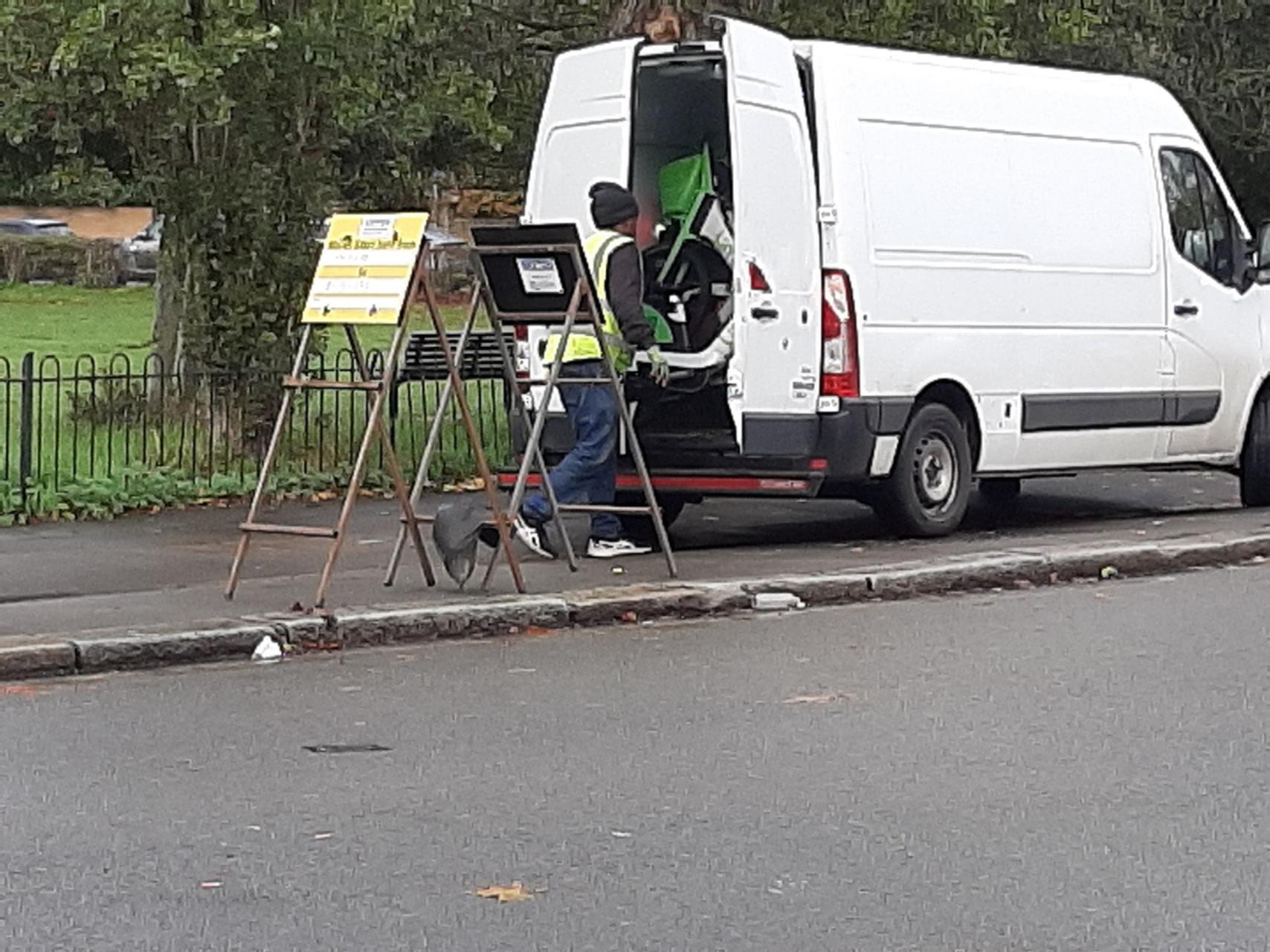
Operatives will still be needed to remove bikes if necessary
Boots on the ground are still needed
Cllr Osborne, however, didn’t see regulation as a panacea and though he welcomed a pan-London system, he was sceptical about more enforcement. “You need to have people on the ground who can see and move [bikes] to a better place.”
Walking and Cycling Commissioner Norman responded:
“TfL have been working with London councils and the team in this space. There are shared services and we manage that.”
He also said that “cultural change” was needed and more education to plug any gaps.
What do operators say?
In a separate session, the Transport Committee also put questions to representatives of the four operators, who in the main agreed that the sector, though very important to many Londoners, was not working for everyone. They were not opposed to regulation and were clear that they, too, sought clarity.
Alex Berwin, Vice President of Public Affairs, at Forest said that “operators face a fragmented market. We wrote to the Mayor calling for more clarity and consistency from TfL and the Department of Transport.”

Rider parks a Voi rental bike then takes a photo for the app
A variety of tools are employed
Georgia Heathman, Public Policy Manager UK, for Bolt agreed that it was a “patchwork” service in which infrastructure had not kept up with demand. She said that they require all their customers to park in a bay and used a variety of tools to self-regulate their operation.
“We have teams that will attend parking bays and tidy,” she explained. “When they deploy bikes they only do this where there is capacity. Where bikes haven’t moved for a while, we offer a discounted price.”
As well as sending teams to sites, operators all rely on technology to nudge their customers to park well – for example asking for a photo. At Forest, riders will get a warning, then fines of varying levels – £20, £50 and £100 – then finally a ban.

More parking bays are needed to cope with increased demand
The provision of parking bays
Operators unanimously agreed that the provision of more parking bays was the solution to poorly parked bikes. The Bolt representative said that their customers wanted to park compliantly but were unable to do so.
“Lack of growth of parking to support the demand growth that London has seen is a real challenge,” she added.
“If parking is too confusing, we see worse outcomes,” agreed Alice Pleasant, Deputy Regional Head of Government Relations UK, for Lime.
Forest spokesperson Berwin compared London with Paris which has one over-riding authority and parking bays in almost every street. He said that because “our bikes get used six times a day” they offered better value to a council than a single car that would sit in a bay all day.
More land is needed
Lime executive Pleasant asked if more TfL land could be provided as it was often close to stations and a key aim was to get people to use bikes to link to other forms of transport. Lime has invested heavily in parking bays and offers 3,400 across London.
Assembly member, Neil Garratt, said the dockless e-bike scheme was “a victim of its own success”. He expressed his concern that local authorities had little idea how many bikes were in their boroughs and what the capacity should be. In November 2025, an issue with Lime parking too many bikes around Turnham Green station was an example of how unregulated operations can go wrong.
READ MORE: Bedford Park swamped with Lime bikes
Elly Baker, Deputy Chair, believes that the business model of rental bikes is “increasing dangerous incidents by encouraging casual use”. She observed that people who have their own bike are less likely to run red lights and ride over pavements.
Asked for solutions, Bolt’s representative responded that bike cameras could be used to help catch those that have illegally crossed junctions. Another measure might be to charge by mile rather than minute so that riders aren’t going at full speed to try to keep their charge down.

Lighter model of a lime bike could help reduce accidents to the rider
Code of conduct
Bolt regularly speaks to riders who don’t abide by their code of conduct and currently logs non-compliance by time and location, using identifiers on the bike that the human eye can’t see.
Given that pinpointing an exact bike isn’t foolproof in a congested area, Assembly Member Keith Prince suggested that a larger number on each bike would help the public identify and report bad behaviour.
Are unwieldy bikes safe for riders?
Safety was a primary concern for the Transport Committee. Chair, Caroline Russell, wanted to know what steps were being taken to prevent injuries given that 80 per cent of injuries are suffered by those riding the bikes.
Whilst data exists for fatalities there is less reliable information available about near misses and minor incidents.
Operators across the board have been looking at the design of their bikes. Some revised models are already on the road.
Harry Foskin, Senior Public Policy Manager of Voi Technology, said “we’ve already got a new model where the battery is at the back of the bike”. And Bolt revealed “we have now launched our smaller, lighter bike”.

Forest bike recently left on the pavement in front of a house for several days and not picked up
Lack of data
One of the most worrying aspects of the e-bike sector is that although companies share monthly reports and some contractual agreements with councils require live sharing there is no reliable aggregate data to help plan what is needed for London.
It is expected said Christina Calderato, Director of Strategy for TfL, that live sharing of data will be required from operators as part of the legislation over a pan-London licence, but it was too early to be very prescriptive.
Cycling commissioner Norman said he couldn’t imagine live tracking of every bike given that there are 16,000 kilometres of streets in London. However, he thought that data sharing would be transformative.
A knock-on effect for everyone
“If I was an operator and my licence depended on the behaviour of my customers then I would do everything in my remit to ensure that those customers were behaving better. The sharing of data – within the licensing regime – will change the powers that we’ve got, and it will change behaviour because there will be ramifications.
“It will have a knock-on impact for everyone across the whole ecosystem from riders to the people reporting problems, for the council enforcement teams, to TfL’s perspective and across the whole city.”
Operators were open to sharing data – especially for compiling aggregates – but expressed concerns that there might be competitive disadvantage by giving specific details to their rivals.
Whilst all parties await secondary legislation that will provide clarity on how regulation could work, the discussion at City Hall was a great starting point and the will is there to end the chaos.
Read more stories on The Chiswick Calendar
See also: London Assembly not convinced about robocabs
See also: Mayor of Hounslow launches campaign to raise funds for Dementia charity which cared for his partner
See all the latest stories: Chiswick Calendar News & Features
 Support The Chiswick Calendar
The Chiswick Calendar CIC is a community resource. Please support us by buying us the equivalent of a monthly cup of coffee (or more, if you insist). Click here to support us.We publish a weekly newsletter and update the website with local news and information daily. We are editorially independent.
To subscribe to the weekly newsletter, go here.


