
A busy summer of music at Gunnersbury Park and the noise that follows

Khruangbin performing at a packed Gunnersbury Park, Credit: Victor Frankowski / Hello Content
The sound of summer festivals has become a sound that the whole of Chiswick is now familiar with
Gunnersbury Park is now firmly on the map as a successful London festival host, with rave reviews from many happy customers who have come to the park to enjoy live music. But just as one person’s terrorist is another person’s freedom fighter, one person’s brilliant gig is another’s annoying racket. It’s a classic urban trade-off: the cultural vibrancy and revenue from major events weighed against the demand for residential peace.
For many living near Gunnersbury Park, the sound of the summer festival season isn’t defined by cheering crowds, but by a low-frequency bass that travels through walls and windows. Many residents complain the noise is too loud, or that they can feel it vibrating. What is ‘too loud’ – who decides and how?
Over recent weeks The Chiswick Calendar has received direct messages from readers alongside posts on local forums, raising concerns about how the shows affect the local area. Most focus on noise concerns, notably how far it carries and how long it lasts.
READ ALSO: Row breaks out over Gunnersbury Park festivals
READ ALSO: Waterworks at Gunnersbury Park will go ahead despite residents’ objections
With this weekend marking the end of Gunnersbury Park’s summer festival schedule, it feels like the right moment to look at how that sound is monitored.
We asked Gunnersbury Park how these complaints are handled. They introduced us to Dani Fiumicelli, an independent acoustic consultant who oversees noise monitoring on show nights, and he agreed to let me shadow him on Friday 15 August, when Khruangbin were headlining.
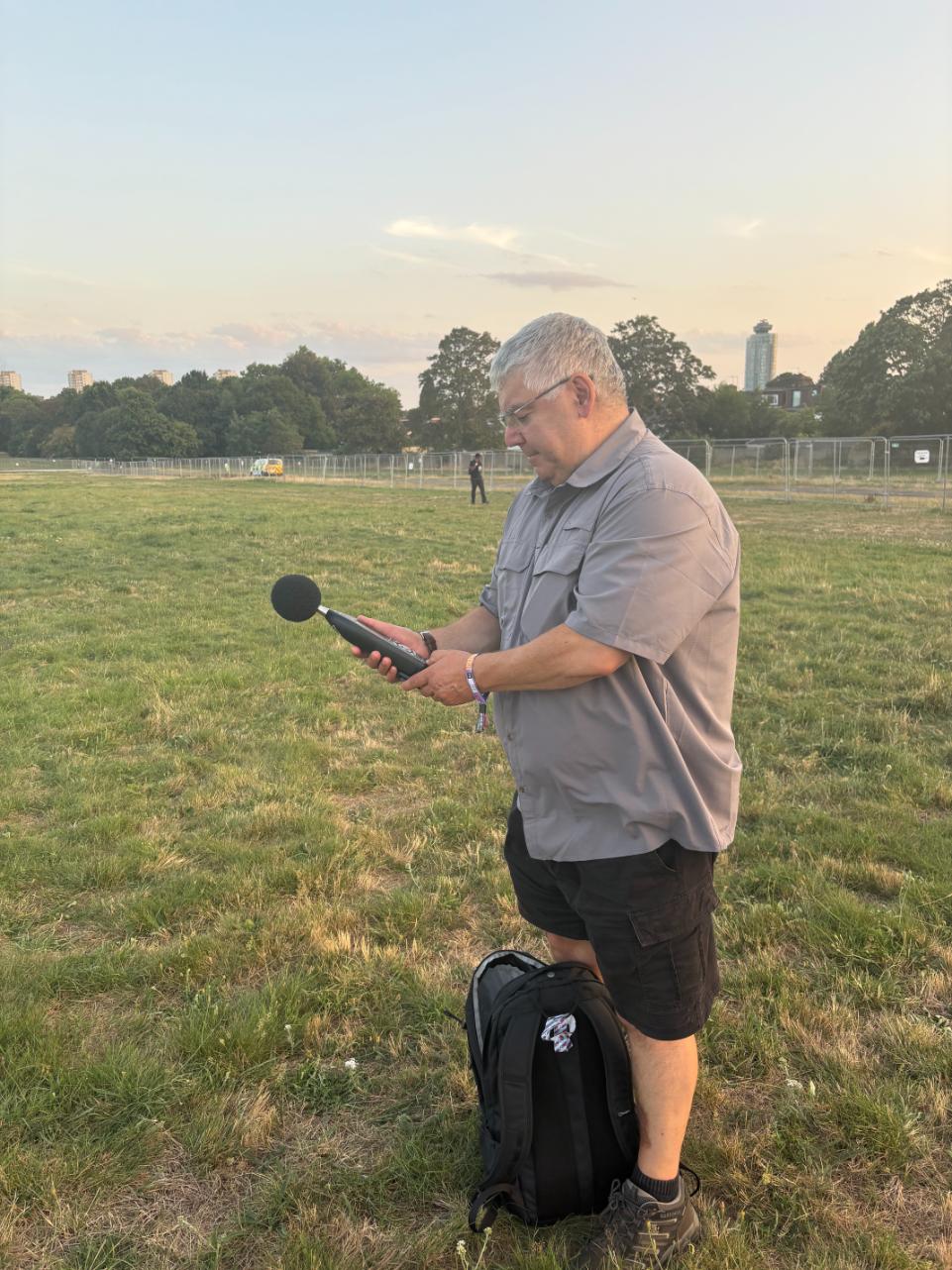
Image: Dani Fiumicelli taking a reading on the edge of Gunnersbury Park
How noise limits are monitored, what happens to complaints, and why some gigs feel louder than others
Vastly experienced and practical, Dani is hired by the park to audit the promoter’s own acoustic team, checking their checks and ensuring actions follow the data.
His job is to translate the science of sound into something manageable. As he puts it simply, “noise is basically unwanted sound.”
Before we went out, he talked me through the basics.
“Two numbers matter on the night,” he explained. “Decibels with A weighting (dBA) measures overall loudness in a way that roughly matches how our ears hear. But it’s the decibels with C weighting (dBC) that often causes the issue. That focuses on the bass, the low-frequency thud you might feel through the walls.”
The licence caps these at 73 dB(A) and 75 dB(C) at agreed spots on nearby streets, a condition stipulated by the local council as part of the event’s official license.
During events, locals are encouraged to report problems to the event’s residents’ hotline (0203 781 0001) or email.
Some locals have suggested going straight to the council, but Dani says that route is slower and usually gets referred back; if you want a quick check and fix while an event is taking place, use the hotline.
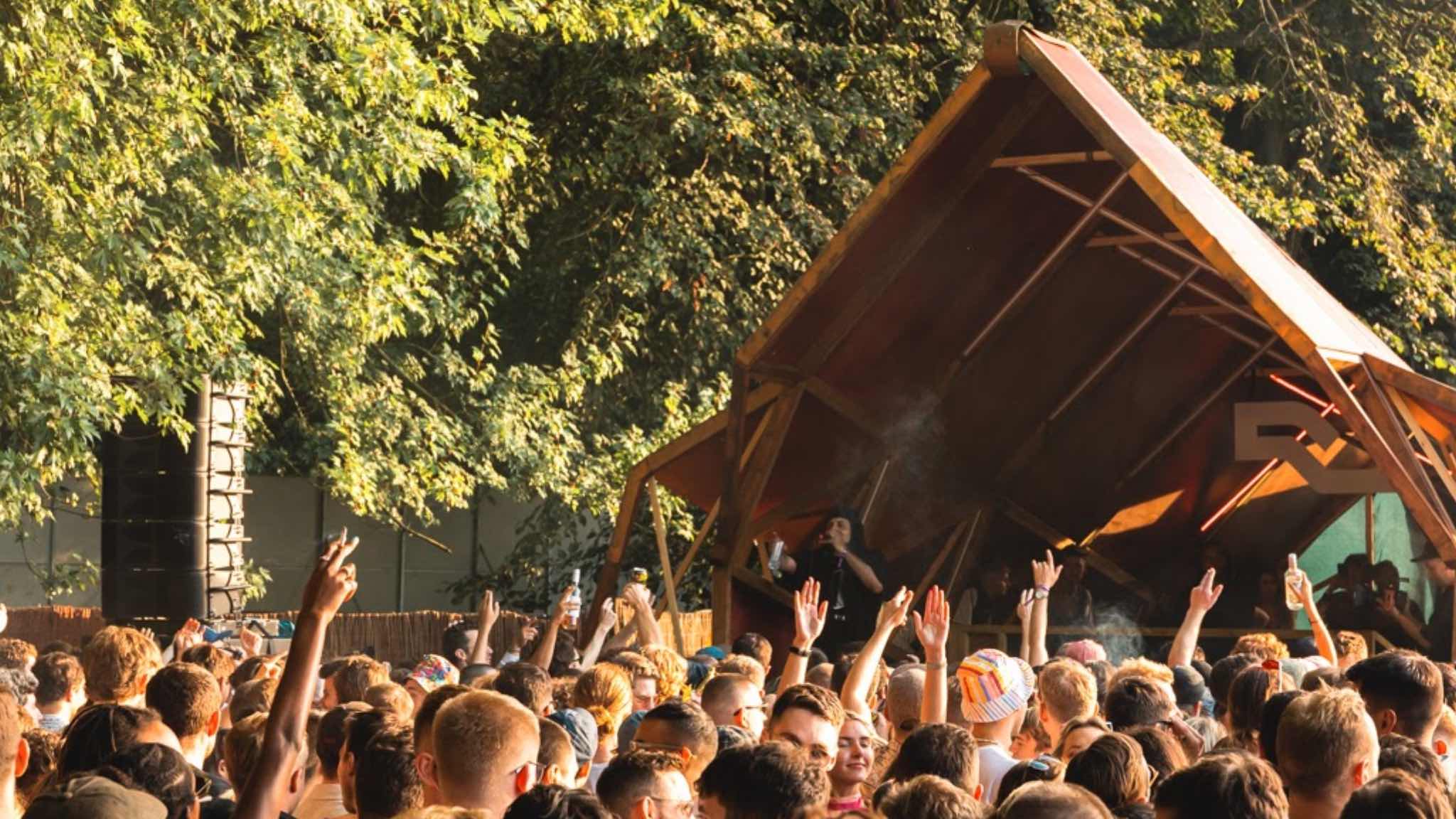
Image: Waterworks festival taking place in 2022
Those messages go to the on-site control room run by the organiser with the park and safety teams.
They log the time and location and send a member of the noise monitoring team to that street to take a calibrated reading with a precision, Class-1 sound level meter, the kind that cost thousands of pounds and are certified to British and international standards.
Dani argues that phone apps or cheap sound meters that concerned locals may use often aren’t calibrated and often misread bass, so they’re not reliable for this job.
If readings at that location are too high, the front of house engineer reduces the overall level or the bass. The operating choice is to keep clear headroom below the caps, not run on the line, and to use practical set-up decisions to reduce spill at sensitive edges.
Increasingly, this involves using predictive sound modelling software before an event to anticipate and mitigate potential noise hotspots based on topography and likely weather conditions.
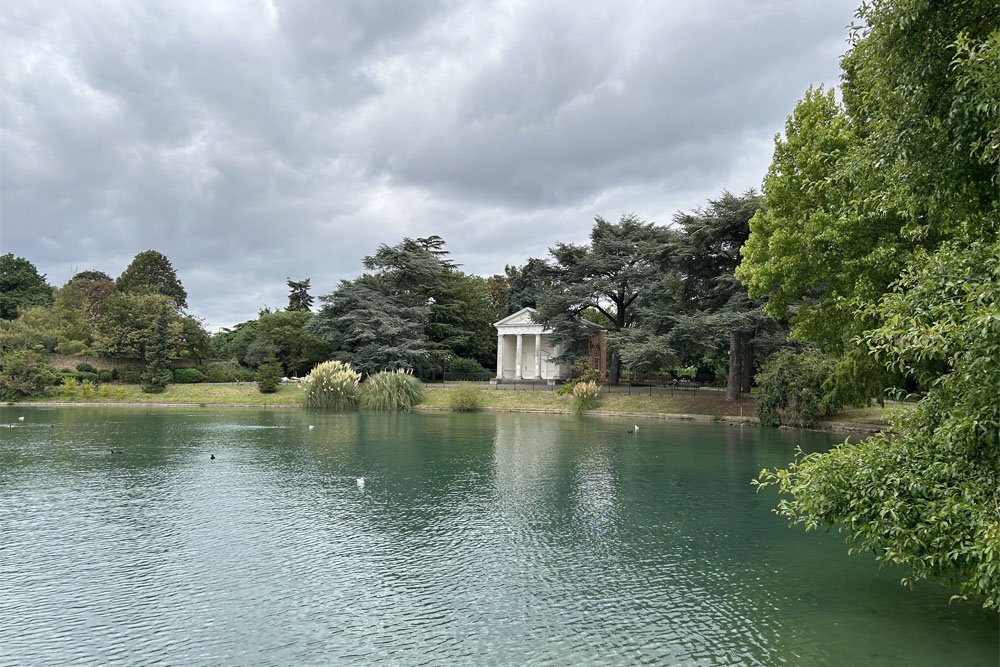
Image: Gunnersbury Park, Credit: Cleopatra Campbell
“The laws of physics are quite immutable”
Timing helps too, Dani tells me, “They finish early here (Gunnersbury Park) on Sundays, and in term time the council pushes that nothing happens before 3:30 to avoid affecting schools”.
But those tweaks sit inside a bigger constraint, as Dani puts it, “The laws of physics are quite immutable”.
Nearer is louder, further is quieter, but wind direction can still nudge which neighbourhood hears more on a given night, especially at distance. And because, in his words, “there is no such perfect metric,” the team cross-checks stage meters with off-site readings and what the hotline reports on the ground.
Genre and duration matter. DJ sets can feel tougher at home even when they are within the limits because of bass. As Dani says, “low frequency noise more easily travels over distance,” so by the time the sound reaches you, the higher notes have faded and the thump remains.
And once that bass is audible, “you need a smaller change for it to be quite a big change,” which is why small tweaks can feel big in a living room. Long DJ sets also have fewer natural pauses than bands, so that thump can feel continuous.
The engineers don’t just turn everything down; they also smooth sharp bits of bass that stick out. They split the sound into narrow “slices” (what they call third-octave bands) and watch that no single slice dominates.
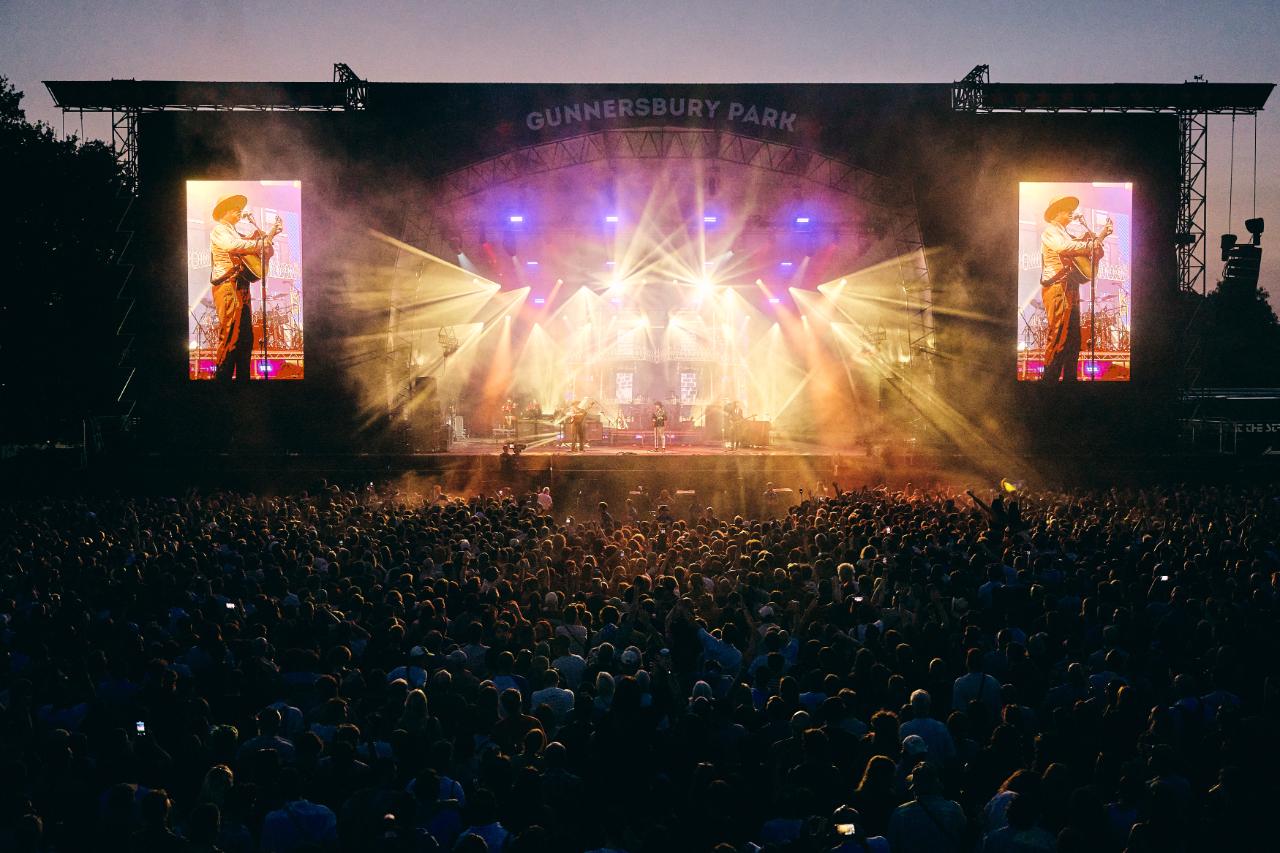
Image: The Libertines performing on August 9, Credit: Mike Massaro/Hello Content
“What we’re trying to avoid,” Dani explains, “is any single low frequency third octave being particularly dominant, they can be really quite harsh on the ear.” In practice that means trimming a narrow bass note rather than killing the whole mix.
These differences were played out on Friday August 8, when PAWSA’s eight-hour DJ set drew markedly more complaints than The Libertines (August 9) and The Smashing Pumpkins (August 10), even though all stayed within the agreed limits.
READ ALSO: The Libertines and The Smashing Pumpkins shine at Gunnersbury Park
Some residents argue the caps themselves aren’t strict enough, but Dani’s job is just to operate within the rules in place.
This weekend’s events; Annie Mac Presents (September 12), Waterworks festival (September 13) and DnB All Stars (September 14), are all electronic music events, so may feel closer to that PAWSA profile for people at home, even if the readings sit inside the limits.
With regards to August 15, it turned out to be a quiet night, slightly frustrating for the purposes of this article, but a successful one for the park and nearby residents.
Khruangbin were headlining, a US band who play melodic, psychedelic-leaning rock with space in the arrangements, which generally sits easier off site than a relentless low end bass.

Image: Khruangbin performing at Gunnersbury Park on August 15, Credit: Victor Frankowski / Hello Content
They’re a band I like, so so I had to check my own bias against Dani’s reminder that “noise is basically unwanted sound.”
Our first call-out was Ealing Road. On the busyish road, the music was a faint beat, almost completely swallowed by the rumble of traffic. Stepping off into a nearby estate, it was a distant pulse, a muffled suggestion of a party rather than an intrusion.
As the evening progressed we received another call out to Lateward Road in Brentford. With the headliner on, the meter again read comfortably inside both caps, which matched what my ears were telling me on the pavement.
Overall, the measurements and what I heard lined up, audible but not intrusive.
Across the whole night, calls to the resident line were in single figures, a small return from neighbourhoods that run to tens of thousands of residents within earshot, and the system did what it’s meant to do, log, check and, although it wasn’t required this time, adjust.

Image: Pete Doherty performing with The Libertines at Gunnersbury Park, Credit: Mike Massaro/Hello Content
I can sympathise however with locals who felt differently during PAWSA’s DJ set the previous week, where the continuous low-end would have felt more intrusive, even within the rules.
READ ALSO: Brockwell Park festivals ruling highlights battle over use of urban parks
Dani’s view, shaped by years on sites like Finsbury Park, Brockwell Park and Clapham Common, is that the pattern is broadly the same across London: there will always be issues wherever you put large shows, the types of complaints are similar, and the numbers aren’t wildly different once you account for scale.
While this single evening demonstrated a noise monitoring system that worked, measured, responsive, and with few call-outs, it doesn’t erase other valid frustrations about park access or clean-up.
However, it does underscore a crucial point in the debate – the frustration for many residents may not stem from a system that is broken, but from one that is functioning correctly within rules they feel are not strict enough.
On the night, the line was held, suggesting the tools for control are in place, even if the wider conversation about a festival’s full impact on its neighbours is far from over.
Read more stories on The Chiswick Calendar
See also: Tower blocks on Great West Road get the go-ahead
See also: Fire at former BBC Television Centre in Shepherd’s Bush
See all the latest stories: Chiswick Calendar News & Features
 Support The Chiswick Calendar
The Chiswick Calendar CIC is a community resource. Please support us by buying us the equivalent of a monthly cup of coffee (or more, if you insist). Click here to support us.We publish a weekly newsletter and update the website with local news and information daily. We are editorially independent.
To subscribe to the weekly newsletter, go here.


