
Residents association submit alternative funding proposals for Gunnersbury Park

Gunnersbury Park; Photograph Jennifer Griffiths
Residents Association suggest mix of grant funding and charitable donations to pay for the park’s upkeep
Gunnersbury Park Garden Estate Residents Association (GPGERA) has submitted its own alternative funding proposals for generating income to run Gunnersbury Park following the cancellation of two of the three festivals planned for this summer and the loss of hundreds of thousands of pounds in expected revenue.
The trust which runs Gunnersbury Park says it relies on the income from the festivals to keep the park going.
The residents group describes its proposals as ‘a more sustainable model for the park’s future’ and ‘a constructive route towards reducing the park’s reliance on large-scale commercial events’.
The mix of funding options they suggest includes:
‘Government grants, National Lottery funding, heritage funding, environmental grants, Community Infrastructure Levy funding, philanthropic support, community fundraising, public-benefit partnerships, membership schemes, health and wellbeing funding, biodiversity funding and more transparent procurement’.
The group claims their proposal identifies ‘potential grant and funding routes with a combined application range of up to approximately £31.4 million, should the CIC, its associated charity and the councils choose to pursue the suggested charitable and public-benefit funding route’.

Gunnersbury Park; Photograph Jennifer Griffiths
Gunnersbury Estate will consider the residents’ group’s proposals at their next Board meeting
Gunnersbury Estate (2026) CIC has said they will consider the proposals at their next Board meeting, but they already apply for any grant funding for which they are eligible.
Gunnersbury Park & Museum heard last October they had secured funding from the Arts Council England, as one of 75 museums being supported by Museum Renewal Fund awards. Three years previously the Arts Council gave them £129,500 per year to cover 2023-25.
READ ALSO: Gunnersbury Park receives Arts Council funding, reducing their reliance on commercial income – 2025
READ ALSO: Gunnersbury Park Museum gets Arts Council funding – 2022
Each grant application has to be tailored specifically to the purpose of the particular grant applied for.
The Arts Council money, specifically for local authority linked museums, was awarded to help them with running costs, but one of the conditions of the grant was that grantees would be expected to undertake additional work to boost business and financial sustainability beyond 31 March 2026.
The £147,000 from the Arts Council is also specifically ringfenced to strengthen the Trust’s capacity to deliver high-quality educational programmes.
The chair of the Gunnersbury Park Trust, Professor James Knowles, has told The Chiswick Calendar the money they make from commercial events goes on everyday running costs such as the £300,000 it costs just to empty the dog poo bins and mow the lawns. They can spend it as they choose, depending on their own priorities.

Gunnersbury Park Museum, formerly the home of the Rothschild family
Gunnersbury Park already benefits from National Lottery money, Arts Council funding, crowd-funding initiatives and donations from well-wishers
The Park also already receives philanthropic donations from well-wishers. Last year Friends of Gunnersbury Park & Museum donated £14,000 towards the renovation of the gardens.
READ ALSO: Friends of Gunnersbury Park & Museum donate £14,000 to renovate the gardens – 2025
The museum, the family home of the Rothschilds in the nineteenth and early twentieth centuries, was reopened to the public in June 2018 after a major refurbishment costing £26m, paid for from the public purse. A major part of that money came from the National Lottery fund.
The Heritage Lottery Fund awarded two grants totalling £9.4 million and Historic England chipped in half a million to repair the terraces and Gothic ruins. Ealing and Hounslow councils funded the remaining costs.
READ ALSO: Gunnersbury Museum reopens after major refurbishment – 2018
Since then, Gunnersbury Park Museum has received more National Lottery funding. In 2022 the National Lottery funded an exhibition on the history of women’s football.
READ ALSO: History of women’s football to be exhibited at Gunnersbury Park – 2022
The Trust has also used crowd-funding to pay for exhibitions:
READ ALSO: Gunnersbury Park Museum fundraiser hits £10,000 – 2023
This year they have set up a new Community Cultural Champions Programme with money from something called the ‘National Portfolio Organisation’, which has provided funding for three years to support how they work with local communities, including community-led programming, Public Programme and exhibitions.
In March, Gunnersbury Park Museum was shortlisted for a National Heritage award, which celebrates excellence across museums, galleries and cultural heritage attractions worldwide:
READ ALSO: Gunnersbury Park Museum shortlisted for National Heritage award
It is hard to see what new grants they could apply for.
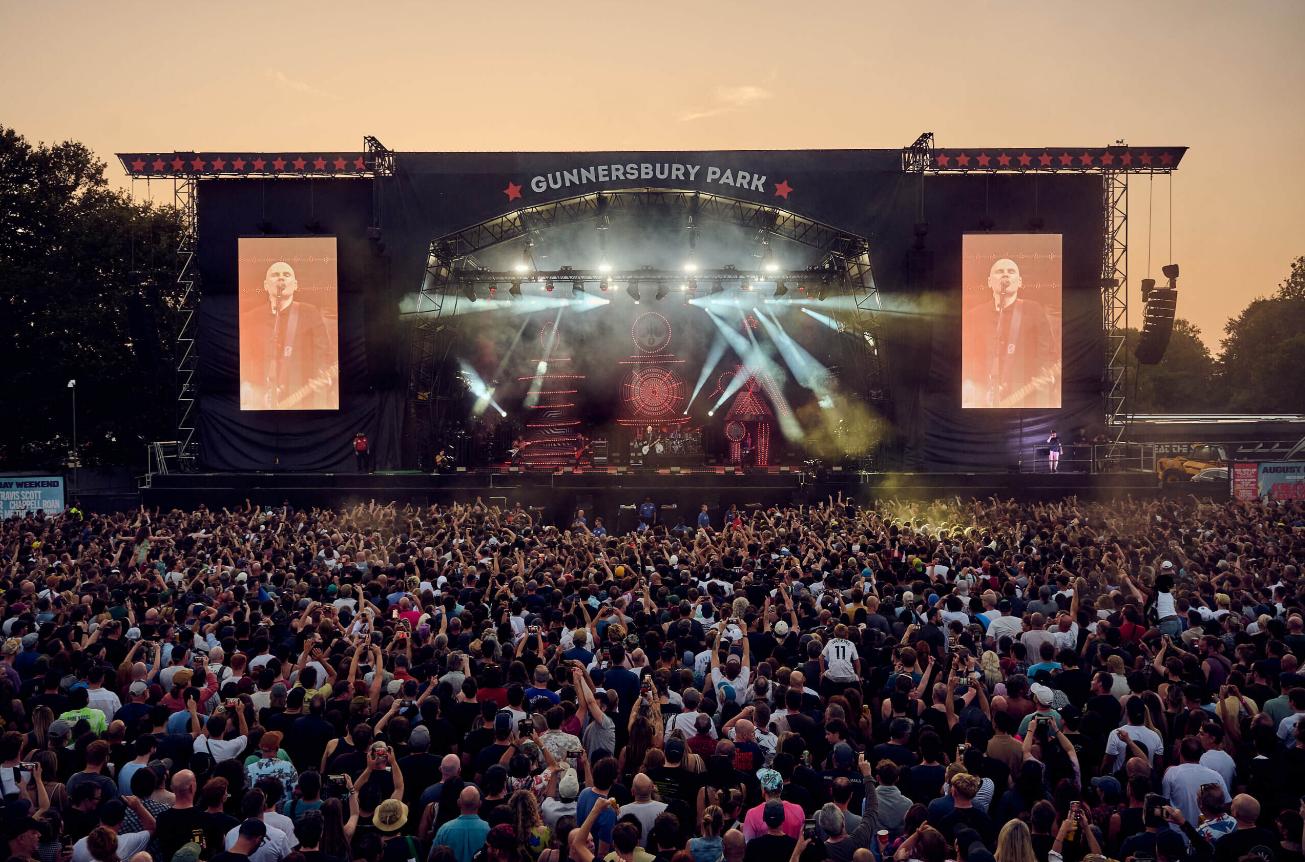
The Smashing Pumpkins playing in the park last summer; Photograph Mike Massaro / Hello Content
Trend away from public funding
Ealing and Hounslow Councils set up the Trust to run Gunnersbury Park, with a subsidiary company specifically to run commercial events, because they were reducing Council funding. Currently they provide joint annual funding of £600,000, but in real terms support from the two councils has declined 48% since 2018 while the Park’s costs have risen.
There is huge competition for Community Infrastructure Levy funding from developers. In February Hounslow Cabinet approved £4.7m in developer funded infrastructure improvements.
Examples of the way the levies are being used are the £701,000 funding to progress the replacement of Brentford Fountain Leisure Centre, covering initial design and engagement and £200,000 for West Middlesex University Hospital to upgrade essential electrical infrastructure.
Hounslow and Ealing’s policy for the past decade has been to reduce the park’s reliance on Council funding, not increase it.

Lovebox – one of the early festivals in the park
Application for ten-year planning permission for events
One of the ways in which the Trust has sought to reduce its costs has been to apply for planning permission for ten years’ worth of events in one go, rather than having to pay consultants for each separate, individual application, which they say will save them millions of pounds in the long run, but this has been opposed by the residents’ association, which also demanded Hounslow Council review the Park’s licence to hold events, which it did in March.
READ ALSO: Gunnersbury residents demand a review of Gunnersbury Park’s licence to hold events
READ ALSO: Gunnersbury Park allowed to keep current noise level for festivals
They were disappointed the licence review by two Labour councillors and one Conservative councillor, Gabriella Giles from Chiswick, resulted in the Park’s licensing conditions remaining largely the same:
‘Although the 2026 premises licence review resulted in some additional conditions, GPGERA does not believe these went far enough to address the central concerns raised by residents.
‘The changes did not meaningfully reduce permitted noise levels, event days or audience capacity. In practical terms, the licence remains largely intact, with the licence holder primarily required to manage existing impacts more effectively, including crowd control, litter, toilets, communication and event management.
‘Residents remain concerned that improved management alone will not resolve the underlying issue of repeated high-impact commercial use in a public park surrounded by homes, schools, wildlife habitat and everyday park users’.
The Gunnersbury Park Garden Estate Residents Association wants the Park to be less reliant on commercial income and say their proposal is intended to support a better future for Gunnersbury Park:
‘One that protects public access, biodiversity, heritage, residential amenity and community wellbeing, while still allowing the park to secure the investment it needs’.
You can read their proposal in its entirety here:
Gunnersbury Park Estate Residents Association suggestions
Read more stories on The Chiswick Calendar
See also: Hounslow Council leader sets out his vision for the next four years
See also: Councillors go out on a wing to support Hounslow Mayor’s chosen charity Age UK
See all the latest stories: Chiswick Calendar News & Features
 Support The Chiswick Calendar
The Chiswick Calendar CIC is a community resource. Please support us by buying us the equivalent of a monthly cup of coffee (or more, if you insist). Click here to support us.We publish a weekly newsletter and update the website with local news and information daily. We are editorially independent.
To subscribe to the weekly newsletter, go here.


