
Impressions of Chiswick School – Rhian Williams shows some visitors from Sweden round

Chiswick School
“Man ska inte köpa grisen i säcken”
The internet is a wonderful thing. I was looking for famous Swedish phrases and it came up with this one.
Translation: ‘One shouldn’t buy the pig in the bag’.
Meaning: ‘Don’t buy something without inspecting it first’.
There were others, such as: ‘There is no cow on the ice’, meaning ‘Don’t worry; there is no immediate danger or rush’; or this one: ‘Now you’ve shat in the blue cupboard’ (don’t ask). But “Man ska inte köpa grisen i säcken” seems the most appropriate.
Chiswick resident and educationalist Rhian Williams has been hosting a group of school leaders from Sweden and they came to visit Chiswick School.
‘An organisation can say almost anything about who they are’, writes Rhian, ‘the interesting question is whether people experience it’, so the Swedes came and took the pig out of the bag for an examination and here’s Rhian’s guest blog about what they found.

The obligatory London sight-seeing trip; Rhian on the left
You Can Tell Who a School Is Before You Read Its Results
What a group of Swedish school leaders noticed at Chiswick School
Guest blog by Rhian Williams
Having lived in Chiswick for 20 years, I’ve watched Chiswick School change from two perspectives: as a local resident, and as someone who has spent most of my working life in education. Over that time, the school has grown, its reputation locally has changed significantly, and it has increasingly become a school that families actively want their children to attend.
More recently, I have got to know the Headteacher, Laura Ellener, and that has given me a much clearer understanding of the leadership behind that journey and why the improvement has been so sustained.
Over the past few months, I’ve been working with a group of school leaders from Drottning Blanka in Sweden, helping to shape their visit to London and connect them with three schools where they could see different approaches in practice, ask questions and spend time understanding what sat behind the work they were observing.
Thankfully, their English was perfect, which was fortunate because my Swedish begins and ends somewhere between the IKEA one way system and the meatballs.
They had three school visits, Chiswick School was one of those visits, and I was fascinated afterwards by what the Swedish leaders chose to talk about because, although they had come with detailed questions about leadership, teaching, school improvement and professional learning, some of the things that stayed with them most strongly were much more human.


Their welcome probably helped. The school choir sang for them as they arrived and several of the Swedish leaders told me afterwards that it had brought tears to their eyes. That is quite a high bar to set before anyone has even sat down for the first meeting.
I did briefly consider trying to recreate the effect in the workshop — I am Welsh, after all — but sadly I was missing the choir, the harmonies and, arguably, the talent. More importantly, though, the performance did not sit in isolation; it became part of a much wider impression of who the school is.
As they moved around the building, they noticed staff positively engaging and acknowledging pupils, the visibility of teachers and leaders throughout the day, and especially that staff were present at the end of the day, saying goodbye as pupils left.
They talked about the ease of those interactions rather than anything feeling staged for visitors. These can sound like small things when written down, but they are often the things that tell us most about culture because they reveal what is normal when nobody is making a special effort to demonstrate the school’s values.
Although I’ve never taught in Chiswick School, I felt a sense of pride at what has been achieved and is being offered to pupils locally. It matters to me because organisations can say almost anything about who they are; the interesting question is whether people experience it.
A school can talk about belonging, aspiration, respect and inclusion, but pupils experience those words through whether they are noticed, how adults speak to them, how much is expected of them and whether the relationships around them feel genuine.

The Swedish leaders were looking very carefully at Chiswick School through that lens, even if they would not necessarily have described it in those terms.
They also noticed that the warmth of the school did not come at the expense of expectation; if anything, the two seemed to reinforce one another. Pupils were known and valued, but they were also expected to think, question, explain and achieve highly.
In some schools, relationships, inclusion and standards can feel as though they sit in separate boxes, but Chiswick School seemed to bring them together very naturally: high expectations because pupils are valued, not in spite of it. For me, that is what creates the conditions for young people to belong and maximise their potential.
Laura’s leadership came up repeatedly in their reflections and, having watched the school’s journey locally over the years I’ve lived here, I loved hearing them recognise what I have increasingly come to see myself.
The visitors could see the improvement, the growth and the confidence of the school, but they were also interested in the leadership underneath it and the clarity of expectation that seemed to run through the organisation.
Now that I know Laura, I can understand much more clearly how that improvement has happened, because there is a very strong sense of who the school wants to be, not simply what it wants to achieve.


Those observations raise questions that reach beyond a single school visit: who are we when things are going well, and when things become difficult? How do we behave towards one another, what do we tolerate, what do we notice, and what does all of that tell pupils about the organisation they belong to?
Chiswick School gave the Swedish leaders plenty to think about in that respect because they were not simply describing strategies when they talked to me afterwards; they were describing an experience.
At the end of the visits, we got together for a workshop to make sense of everything they had seen across the three schools. By that stage there were enough Post-it notes on the table to make any educationalist feel immediately at home.
We eventually to sorted their learning into three categories: Take, Adapt and Leave. Leave was the hardest part of that workshop because they had learned so much. Different countries, different structures and different terminology, but a shared belief that children and young people have to remain at the heart of who we are as schools and leaders.
For me, those reflections come back to a simple belief that underpins good leadership: who we are shapes how we lead, how we relate to others and, ultimately, what people experience of us.
In a school, that means the real test of the organisation is not simply what appears in a strategy document or on a website, but what pupils actually experience every day through the behaviour, expectations and relationships of the adults around them.

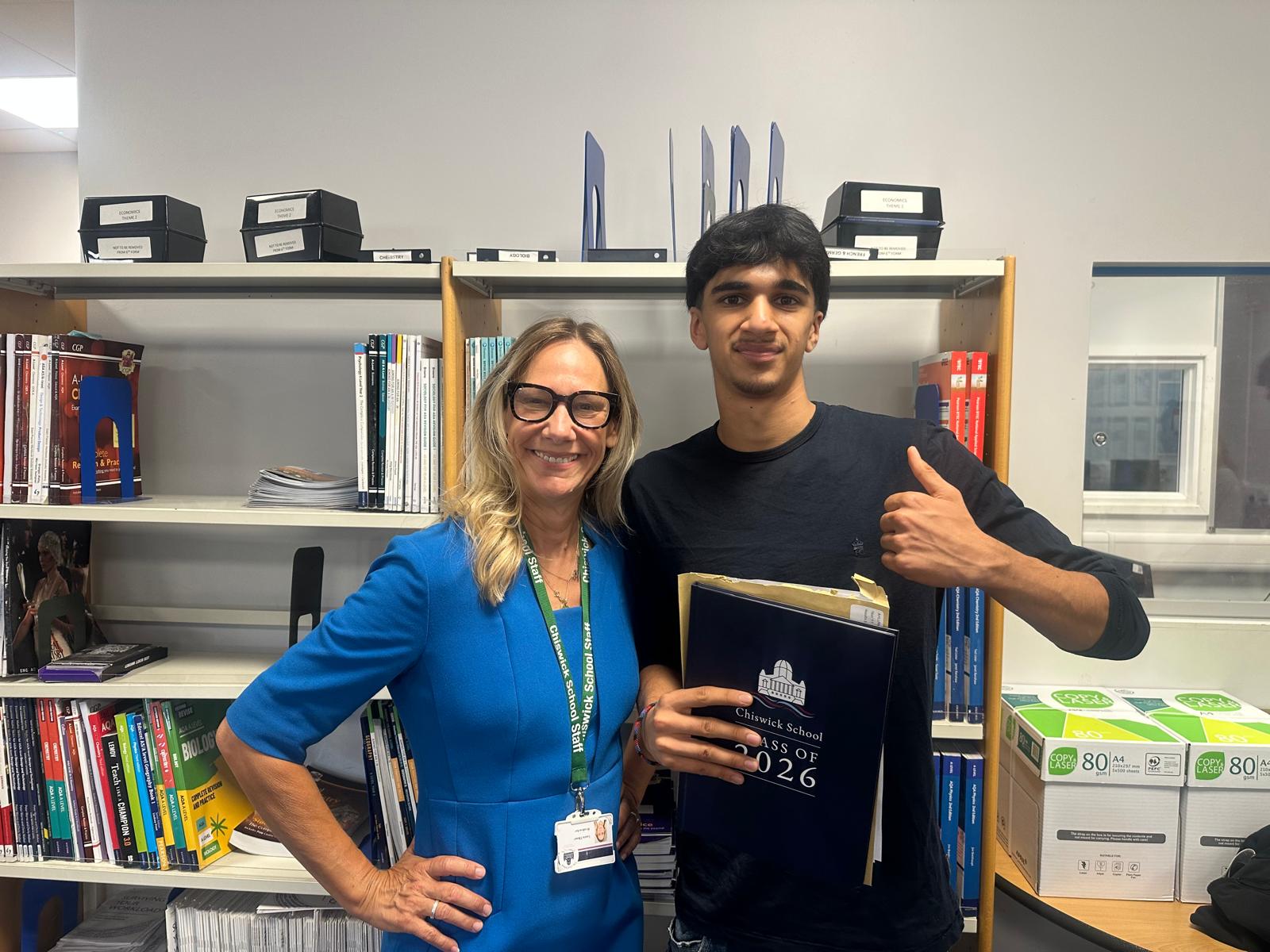
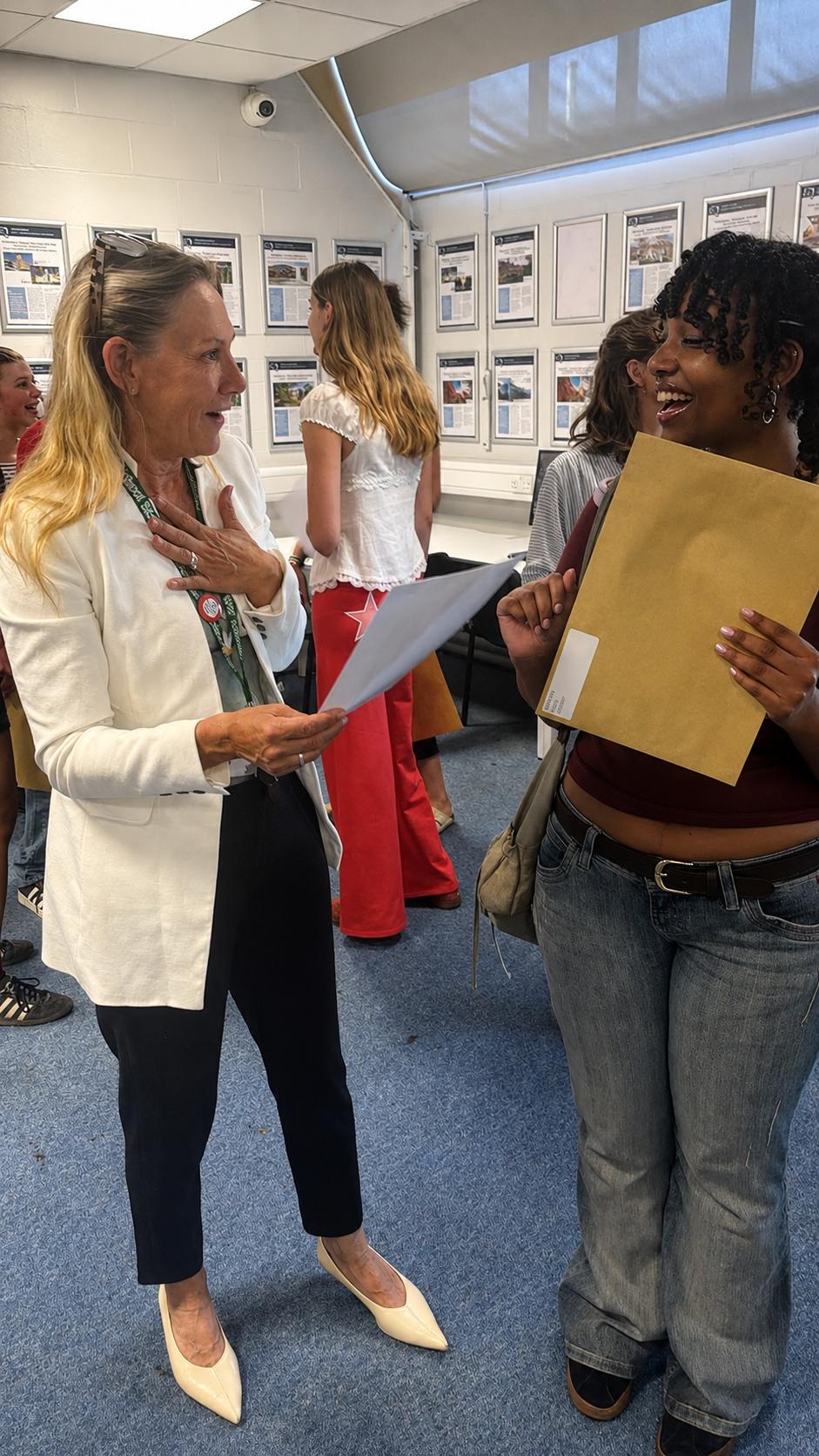
Chiswick head teacher Laura Ellener (L) celebrating achievements with students
After 20 years of watching Chiswick School as both a resident and an educationalist, I rather enjoyed having a group of Swedish school leaders remind me to look at our local school afresh.
Sometimes it takes visitors travelling hundreds of miles to notice what is happening on our doorstep. What they noticed was not simply what the school does well, but who it has become and what that means for pupils every day.
Before you read a school’s results, you can begin to understand who it is through the everyday relationships and expectations that help pupils belong, learn and achieve.
Rhian Williams is a Chiswick resident and education leader who has worked across schools, educational organisations, local authorities and leadership development in the UK and internationally.
Read more stories on The Chiswick Calendar
See also: Francesca Annis comes to Chiswick Cinema for the Shakespeare on Screen season
See all the latest stories: Chiswick Calendar News & Features
 Support The Chiswick Calendar
The Chiswick Calendar CIC is a community resource. Please support us by buying us the equivalent of a monthly cup of coffee (or more, if you insist). Click here to support us.We publish a weekly newsletter and update the website with local news and information daily. We are editorially independent.
To subscribe to the weekly newsletter, go here.


